In this series of blogs, I explore the detailed musical depths of The Lord of the Rings: The Rings of Power. For a comprehensive look at my score for the series, explore my previous blog entries here, and check out the soundtrack albums (a compilation for each season and a comprehensive album for each episode) available on all platforms.
SCORING EPISODE 208
“SHADOW AND FLAME”

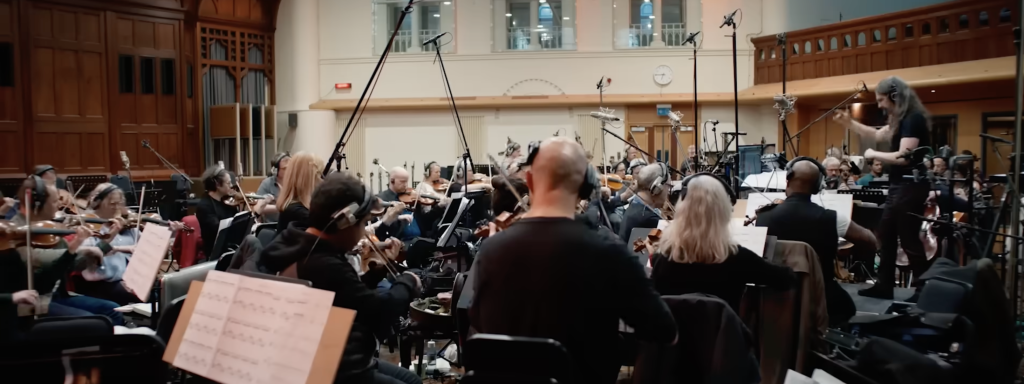
I wrote that the previous episode, “Doomed to Die,” was the most massive episode I have ever scored. While its follow-up, “Shadow and Flame,” isn’t bigger in terms of action spectacle, the mounting payoffs of long-running character arcs, shocking twists, and devastating deaths combined to present an emotionally charged challenge. And the clock was ticking! I started to write the finale on April 1, 2024, knowing full well that on April 23 I had to be on a flight bound for London to conduct recording sessions and shoot promo material for the series. I was already grappling with exhaustion, having worked long days with virtually no days off for seven months, but I wanted to make sure my score for this final episode matched the story’s epic scale and operatic tone.
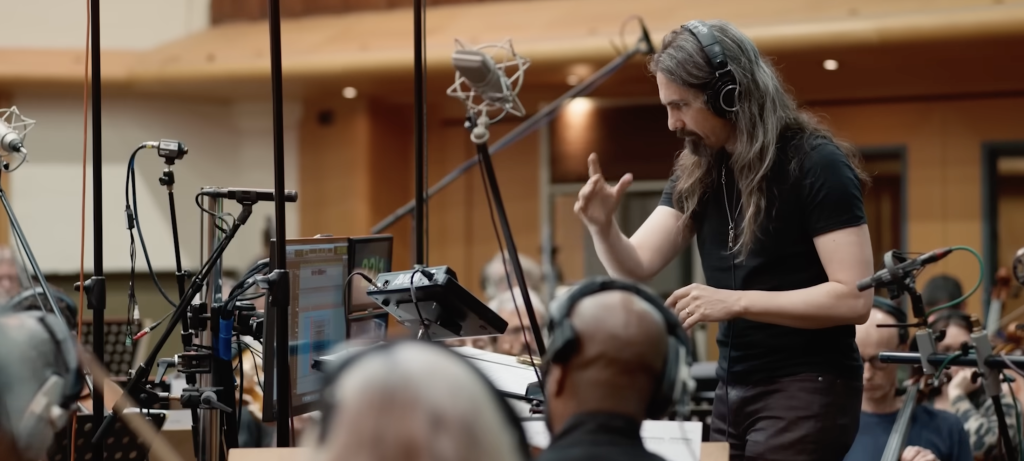
I had no choice but to muster the creative strength to write this epic score in a scant three weeks. I finished the first draft of the episode’s majestic finale piece, “The Sun Yet Shines,” mere hours before I got on that plane.
DURIN’S BANE
SPOILERS AHEAD: “Shadow and Flame” begins in Khazad-dûm, as Prince Durin steps into focus from a distant foreground. With economical visual storytelling, the audience understands that the depth of Sauron’s influence is finally becoming clear to Durin. A funereal male choir sings a low setting of the Khazad-dûm theme, with lyrics in Khuzdul, Tolkien’s Dwarven language. “Uthûn khôzudu, qomukt ushgalôm” means “Keep of the Dwarves, sealed away.”
Durin finds Disa comforting a wounded survivor of his father’s attack. Urgent celli and basses spin up an ominous motor of oscillating minor thirds, a technique I frequently employ to raise the stakes. Knowing they may never see one another again, Durin kisses Disa before he descends into the mines to confront his father, while the orchestra swells with a sweeping, romantic rendition of the Durin theme.

In the mines, Prince Durin finds his father hammering away at a crumbling rock wall. Trying to appeal to him, the prince reminisces about how they would arm wrestle when he was young. A flash of recognition crosses the king’s face, supported by a solo cello offering a plaintive, vibrato-laden rendition of the Khazad-dûm theme. Over the last two episodes, the score has increasingly given the prince the musical colors once reserved for the father, regal low brass, implying he is growing ready to lead. Here, the score does the opposite: the solo cello is one of the prince’s primary instruments and yet, in this intimate moment of connection, it carries the King’s theme, suggesting perhaps the prince’s pleas are being heard. Alas, once Prince Durin says, “I beg you,” his father slips back under the influence of the ring. Dark trombones enter with the Khazad-dûm theme, suggesting the king is regaining control over the scene. The king spins around and smashes through the brittle wall behind him.
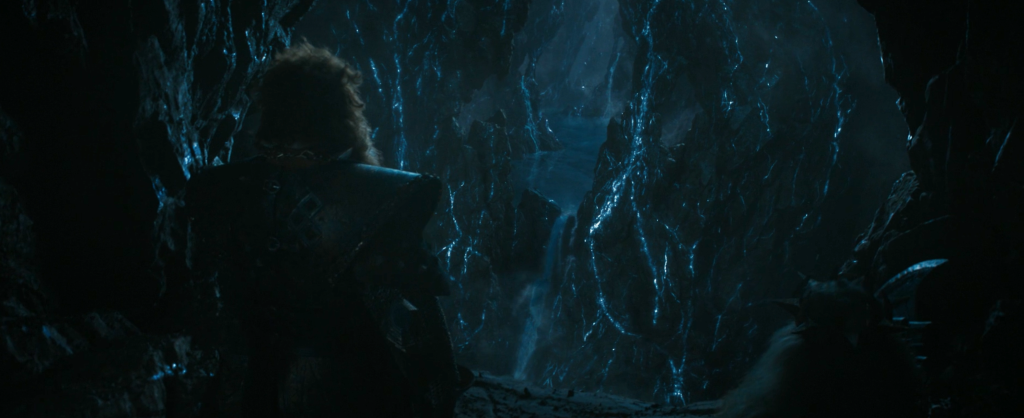
Dramatic music swells as father and son step inside a newly opened cave. Sopranos and altos sing ethereal statements of the Rings theme chords with a text in Quenya, one of Tolkien’s Elven languages. “Oialëa kala” means “Eternal light.” As veins of silvery mithril glitter, regal French horns and deep male singers exalt the vast fortune with an uplifting phrase in Khuzdul, “Qorm ag garân, aklan udimt ushqorz,” meaning “Gold and treasure, light deep underground.”

Prince Durin calmly reminds his father that the mountain is not theirs, while his solo cello soars from its high register, offering an emotional plea of the Prince Durin theme. As his father smiles back, perhaps understanding, a foreboding yellow glow suddenly warms his face.
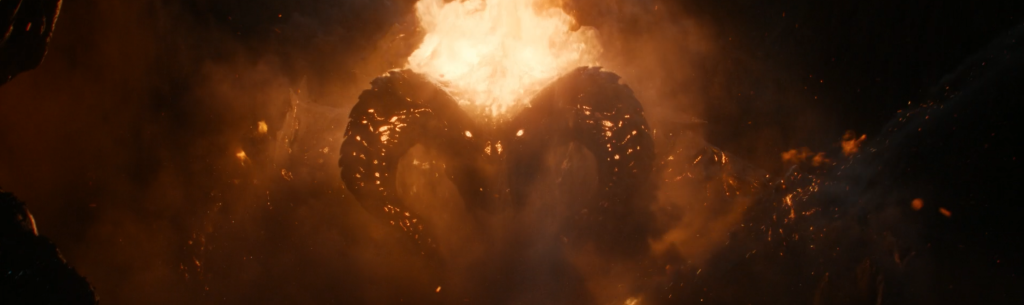
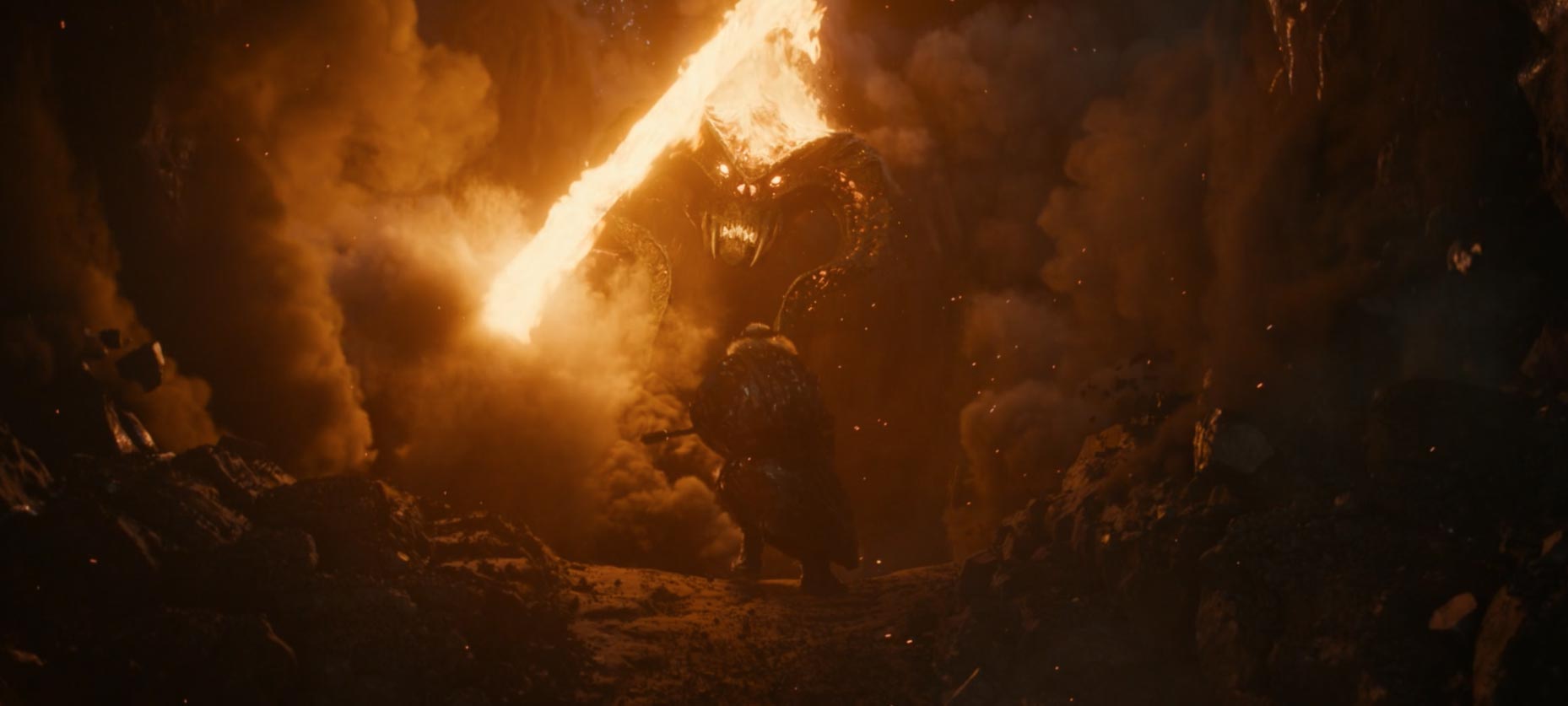
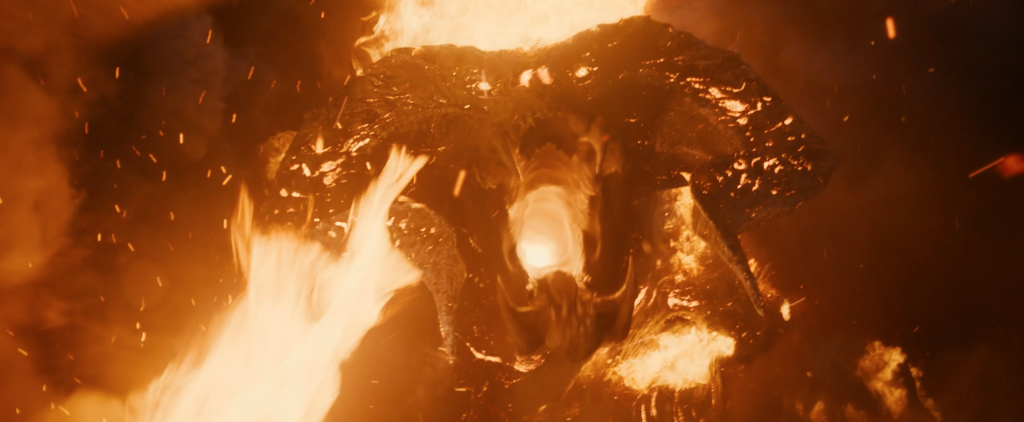
A mighty Balrog of Morgoth arises from the depths of the cave the king has just unearthed. I reached into my grab bag of favorite orchestral horror techniques, inspired particularly by the works of Elliot Goldenthal, James Horner, and Jerry Goldsmith. Screaming French horns violently rip up to their top-most register as the beast roars, while strings ripple like the winds of a tornado as its famously enigmatic wings of smoke beat. Deep male choir singers offer words of terror.
Khuzdul:
Aphzû ur udûm, ankhar nagtu qomukt ushgalôm.
Uruzudn, gabil ankhar.
English:
Attack from the deep, force of the earth sealed away
Disaster, great power.
The cliff face collapses beneath the Balrog’s massive weight and it tumbles to a ledge below, accompanied by a descending flourish from the orchestra.

A somber tone overtakes the score as the visuals drift into a surreal slow motion. A graceful cello ostinato arpeggiates through the soundtrack, while a gentle male choir offers pastoral harmonic support, singing gently, as if a lullaby. While his stunned son watches in awe and terror, King Durin at last removes his Ring of Power, sets it on the stone at his feet, and asks his son for forgiveness.

The luscious string ostinato repeats a second time, but this time leaps up to the violins and violas, in dramatic octaves. As the sound effects fade to the background, the music swells with operatic majesty as regal brass enter. Sopranos and altos join the male singers to project a poetic lyric.
Khuzdul:
Azban, athrân, afzug, ashlâm.
Ankhar zaban ur alba nugûl, urgiz,
kada ankhar nagtu.
Khabru khôzudu, îqron shamâru.
English:
Strength, loyalty, trust, solitude.
Power stronger than any sorcery, army,
or force of the earth.
King of the Dwarves, sacrifice of love.
In a noble effort to save his son, his people, and his soul, King Durin charges towards the creature. Disa and her fellow Dwarves hold the prince back before he can follow. The king’s axe meets the Balrog’s flaming weapon with an impact that sends shockwaves, collapsing the rock walls around them. Here, the orchestra swells with luscious harmonies that build towards an expected harmonic resolution that never comes. Instead, the visuals fade to black as the rock walls tumble down, and the music ceases abruptly on an unresolved chord, leaving the fate of Khazad-dûm in question.
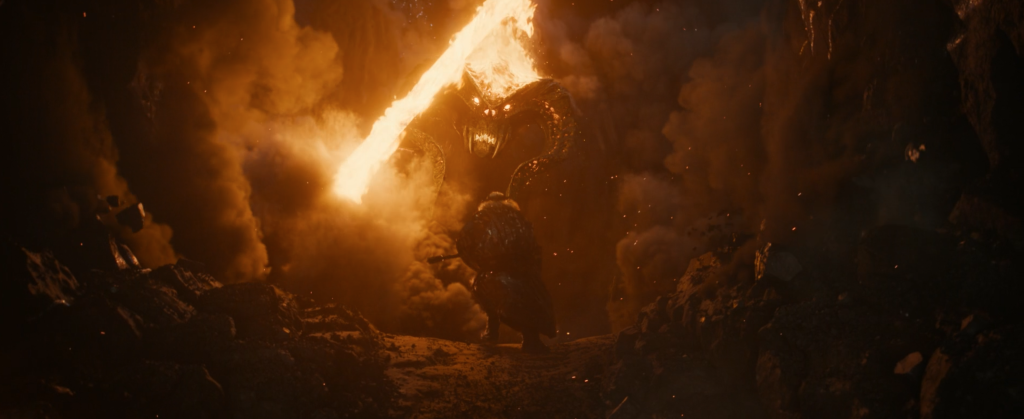
As with “Nolwa Mahtar” in season one, this cue was not intended to be thematically significant. I simply wanted to write something that would make this devastating moment memorable and emotionally impactful. I wanted this piece of music to feel like it is commenting on both the father and son equally, a goal that would be cluttered if I quoted either of their melodic themes. I must confess, though, this musical moment has really stuck with me, and has seemingly made an impression on fans. Perhaps one day it will follow “Nolwa Mahtar” and return to become a proper narrative theme.
Peter Mullan and Owain Arthur, the actors portraying father and son respectively, brought a heartfelt chemistry to their scenes throughout the past two seasons. I felt genuine loss as I completed this scene, realizing I would likely never work with a scene featuring these two characters together again.
THE DARK WIZARD
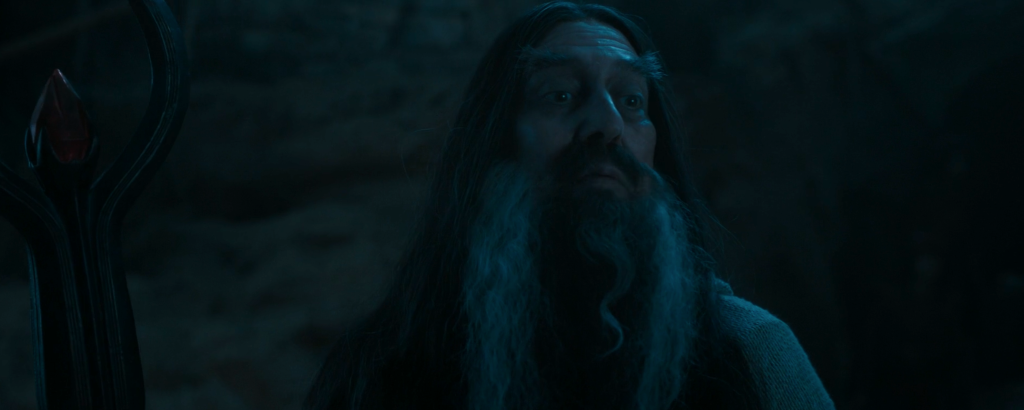
Far away from the catastrophe at Khazad-dûm, the Stranger enters the Stoors’ village, having clearly given up on his quest to find his staff and chosen instead to rescue his friends. The Bulgarian women’s choir offers a whisper of the Rhûn theme, saying, “J’aišäd i Raibo,” which means “The shrine at the border” in Tolkien’s Rhûnic language.

He stealthily makes his way through the dark village, while a high bassoon solo slithers across eerie string clusters, pierced occasionally by muted trombone snarls. I love scoring quiet, tense moments like this because it gives me the opportunity to draw from absolutely classic orchestration techniques like these!
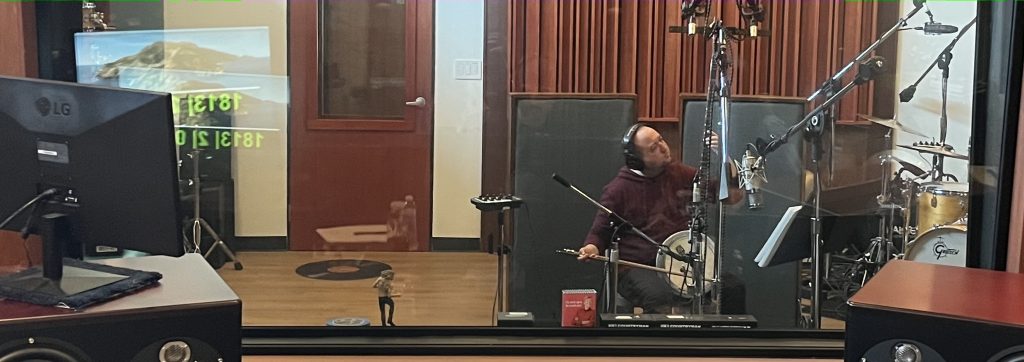
The Dark Wizard approaches the Stranger, and a Turkish yaylı tanbur emerges, performed by Malachai Komanoff Bandy, carrying a serpentine statement of the Dark Wizard’s Rhûn theme variant. Tensions escalate further when the Guadrim appear, holding Nori and Poppy at knifepoint. As the Dark Wizard and the Guadrim leader argue, the Bulgarian women’s choir announces, “Lilebór lilúneba,” a Rhûnic phrase meaning “Masked riders.” The enigmatic sorcerer mercilessly murders the nomadic mercenary, causing the remaining Guadrim to scatter. The Harfoots run to the Stranger, while a pennywhistle solo breathes a sigh of musical relief, Nori’s theme.
As the rest of the Stoors emerge from their homes, the Dark Wizard offers the Stranger the opportunity to join him in vanquishing Sauron so they might rule Middle-earth together. Unaffected by temptation for power, the Stranger defies him, supported by a proud statement of his theme in orchestral celli. In response, the Dark Wizard uses his powers to bring down the cliffs around them! Halflings scatter in all directions, while the Bulgarian gadulka shreds a fast variant of the Rhûn ostinato above an intense percussion groove from darbuka and qarkabeb. The Bulgarian women’s choir proclaims the Rhûn theme with a terrifying lyric.
Rhûnic:
Rodul ṅčul-feg!
I Šigór i Lún,
I Lurg i Bauvailun, fú nimžil.
English:
Lift thy staff!
The Dark Wizard,
The Threat Unseen, under moonlight.
Just as boulders are about to crush every Stoor and Harfoot in the canyon, they suddenly levitate in midair, then miraculously rise, revealing the Stranger, surprising even himself as he employs his own magic to purchase a few fleeting seconds for escape. Soaring French horns blast a heroic fanfare of the Stranger theme, while magnificent choir chords cheer for him in Quenya. “Qualie hyanalin, kallo!” means “Sacrifice yourself, hero!”
THE WHITE FLAME
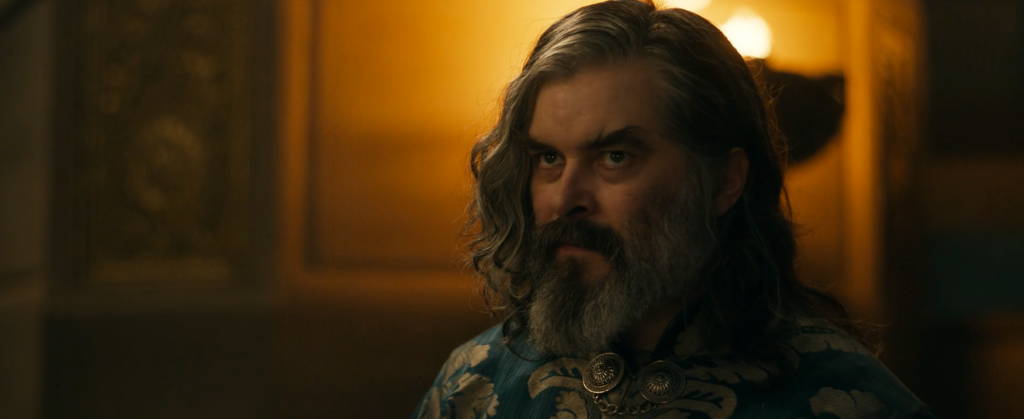
Meanwhile, in Númenor, Eärien summons the leaders of the Faithful before Pharazôn, as the frame drum rhythm of the Númenor theme engages with heavy foreboding over an ominous low cello and bass drone. Pharazôn declares all Faithful traitors, triggering a midnight raid on the city streets.
Over the course of season two, the harmonic and orchestral beauty of the Númenor theme has been darkened. Just as Númenor’s noble monarchy has been overtaken by fascism, so too has its uplifting melody built from major chords been diminished into dark minor chords. As fighting erupts, both in the court and in the streets below, a low male chorale bursts forth with a prophetic lyric in Adûnaic, Tolkien’s language of Númenor. “Kātha anīm azgaram,” bluntly means “All men wage war.”

Once again, the white leaves of Nimloth, the fabled tree of Númenor, rain down upon the city, a phenomenon established in the first season to represent an ill omen, the tears of the Valar. Here, sopranos and altos weep the melody of the Faithful theme with a prophetic warning in Quenya, “Sinwa, ambar sina lantuva,” meaning “Inevitable, this world will fall.” However, the relentless string triplet arpeggios of the King’s Men theme seem to ignore the pleas for peace from the female singers.
Elendil escapes capture and makes his way to Míriel’s chamber. Against the pulse of dramatic, churning low strings, the violins and violas pick up the Faithful theme. While this theme has represented several relationships and characters, I have taken care this season to ensure its use in scenes with Elendil and Míriel feel particularly romantic, acknowledging the growing chemistry between them. As Míriel makes clear she does not intend to flee with Elendil, the propulsive energy in the music drains, stumbling down to a bed of tense tremolo strings.
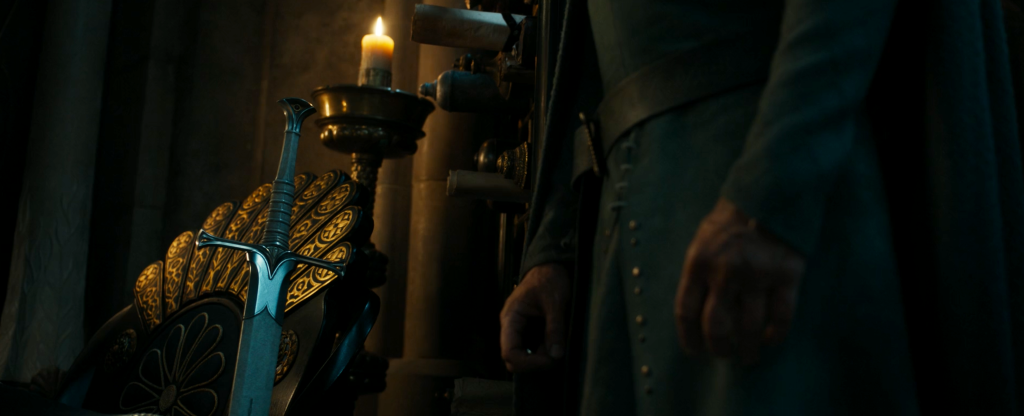
Míriel nods to a blade standing against the wall and introduces it by name: Narsil. Fans of the books and films will recognize this blade instantly, though I won’t spoil its fate here. I hope that even fans unfamiliar with the sword’s significance will feel chills down the spine as Elendil picks it up, aided by a heavenly chorale from the sopranos and altos, singing in Quenya. “I kallo túka maikarya, Silmea nár” means “The hero draws his weapon, The Red and White Flame.” A solo trumpet (a frequent color for Elendil, befitting a warrior and leader of soldiers) calls forth a noble rendition of the Faithful theme as he beholds the scabbard, before a majestic orchestral swell beckons him to unsheathe it. He stares at the blade, at his destiny, with wonder and awe.
THE FALL OF EREGION
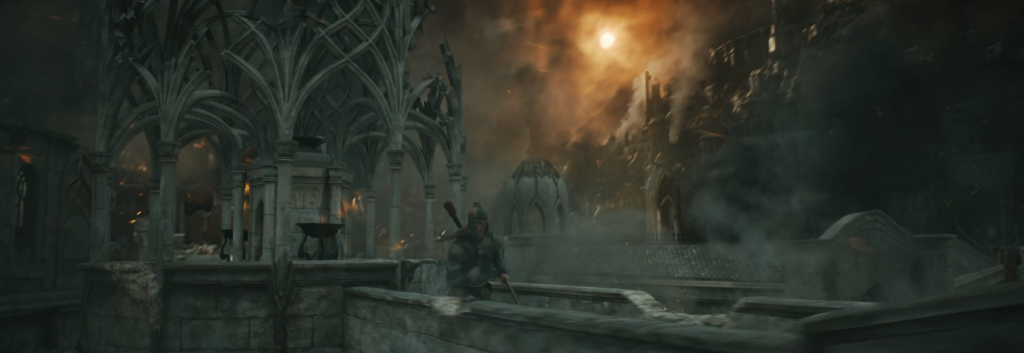
Far away, bright fireballs slice through clouds of thick black smoke to crash down upon the ruins of Eregion, while legions of Orcs flood through the crumbling walls like rats. Adar’s mighty march supports low brass blaring his melody. Mieskuoro Huutajat, a Finnish male choir that specializes in screams, chants in Black Speech, the language of Mordor, “Nampat-sha ghâsh! Nampat, bagronkat!” meaning “Death with fire! Death, suffering!”
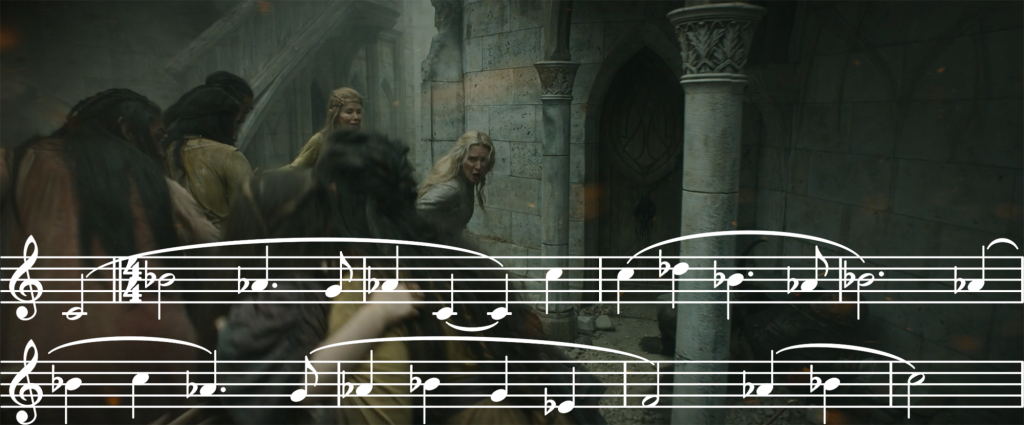
In the most technically stunning shot of the series thus far, the camera tracks marauding Orcs, then follows an arrow up to the rooftops, where desperate Elven archers flee. Across this bloodshed, sopranos and altos sing an ironic, tragic lyric in Quenya, “Anwa mírë Eldanóreva,” meaning “The very jewel of Elvendom.” The unbroken shot continues seamlessly to the ground, where Galadriel helps women and children flee to safety. One of the score’s most brassy and heroic renditions yet of her theme propels her as she whisks them towards the secret tunnel. The choir urges her forward with a proud Quenya text, “Ála nure naxa,” meaning “Do not bow down to obey evil.”
Meanwhile, inside the crumbling forge tower, Sauron torments a broken Celebrimbor, who refuses to reveal the location of the nine Rings of Power. This powerful scene marks the last between actors Charles Edwards and Charlie Vickers, who provided this season, in my opinion, with its most gripping storyline. Inspired by their nuanced performances, I let most of this scene play out with no music, which also provided a much-needed respite from the onslaught of score thus far.
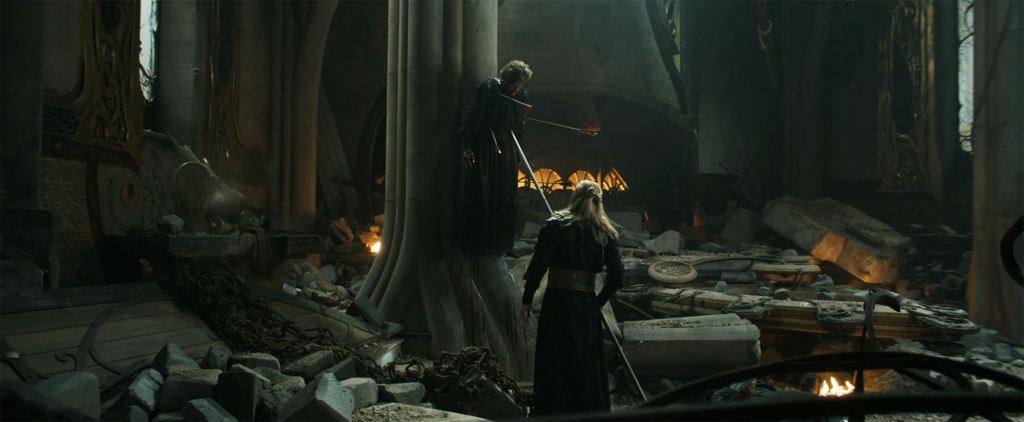
Music finally sneaks in as Sauron picks up a spear, threatening not to kill the captive Celebrimbor, but to keep him alive. Here, the soundtrack swells with the disfigured vocal and bell tones I have used throughout the season to suggest Sauron’s magical influence over others. Here, it is stated so loudly it is practically declarative: Sauron believes he is in control. This time, however, these tones ring hollow. Celebrimbor proves that even near death he is not defeated. Celebrimbor rises, even as arrows protrude his limbs, and taunts Sauron, mocking him with the deepest of insults, “Shadow of Morgoth.” With his innermost insecurity triggered, Sauron skewers Celebrimbor, raising him like a bloody banner against the pillar. In death, Celebrimbor at last gets the better of Sauron, and his final words, “Sauron, the Lord of the Rings,” reverberate with irony and pity.

Sauron stares at Celebrimbor’s lifeless body with a mixture of many emotions, but the most devastating is that of doubt. Charlie Vickers’s heartfelt performance here left plenty of room in the soundtrack for a haunting solo from child soprano Juno Goode, who offers an ethereal statement of the Rings theme, complete with a foreboding lyric.
Quenya:
Yasse lumbuler kaitar, ulko tave.
Annatar orya kéva, i herumor.
English:
Where the shadows lie, evil endures.
Lord of Gifts rise anew, the Dark Lord.
This theme has been heard dozens of times throughout the season, and yet I managed to give each quotation its own unique personality and perspective. Every scene with these two characters altered their dynamic and ratcheted up the tension, inspiring me to find new dramatic interpretations of this melody. This particular quotation of “Where the Shadows Lie” is, for me, the most emotional, personal, and impactful. I will truly miss scoring scenes with these two characters.
Adar’s lieutenant, Glûg, enters the forge with Orc soldiers by his side, but he does not attack. Sauron turns to him with surprising kindness, and asks for his name. Here, the score swells with a heavenly rendition of the Sauron theme, performed by regal French horns supported by heartfelt major chords. Glûg beholds him with apprehension and fascination.
PASSION IN PELAGIR
On the other side of the mountains, the gentle nylon-string guitar arpeggios of the Estrid theme transition the audience to the Old Númenórean settlement of Pelargir. Olav Luksengård Mjelva’s rustic Hardanger fiddle plays a forlorn quotation of Estrid’s melody as Isildur sits in a hut, holding her knife, pondering the future. Theo enters and they bond over their shared feelings of guilt about their mothers’ deaths. Here, a solo French horn picks up a noble quotation of the Faithful theme (which represents Isildur, as well as his father).

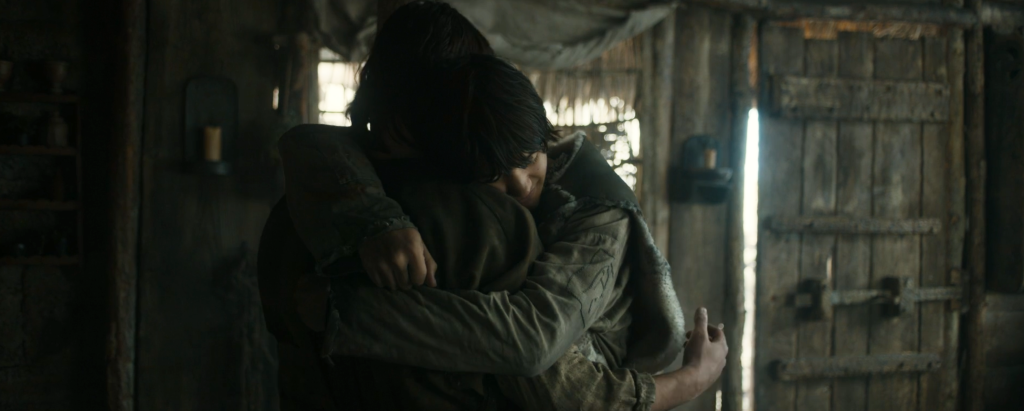
As Theo and Isildur embrace, the soundtrack swells with what I suppose I should call the Theo theme at this point. This passage is really just a new orchestration of the Bronwyn theme, a melody that was played throughout the first season on oboe or English horn. Her lover, Arondir, shared her theme, but I developed for him a heroic brass variation. Here, Theo finally gets his own, played by rich orchestral celli. The celli play in the same baritone register of the male speaking voice (inspired in part by Tyroe Muhafidin’s resonant, low speaking voice when he portrays Theo). Theo’s theme variant has a distinctly masculine contrast to his mother’s high woodwind solo. Bronwyn’s signature instrument has only been heard a handful of times in season two, and time will tell if it is ever heard again. However, her melody lives on in the brass Arondir theme and the cello Theo theme, just as her memory lives on in their hearts.
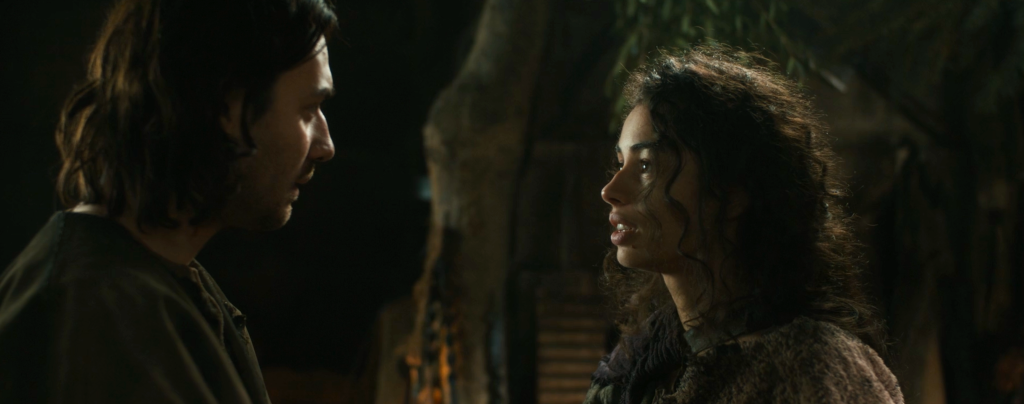
Theo leaves, and Isildur’s simple guitar ostinato gently keeps time while a solo flute faintly whispers his melody. To his surprise, Estrid enters. She confesses she has come to question what she thinks love is, despite being betrothed to another. Here, an English horn and increasingly emotional string chorale enter with the Estrid “B theme.”

I composed this material back when I was scoring “The Eagle and the Sceptre,” as the middle section of her album piece, “Estrid.” I had never until now found a moment to feature it in the series. (There are a handful of other character “B themes” that have yet to make an appearance on screen, including Elendil’s and even Galadriel’s!) To my pleasant surprise, this theme fit the scene with precision, leading into their kiss beautifully. When they embrace, orchestral violins and violas soar on Estrid’s primary melody, supported by Erik Rydvall’s nyckelharpa and the Hardanger fiddle, resulting in one of the season’s most romantic phrases.
Outside, Kemen disembarks from Númenórean sailing ships and, with none of his father’s populist charm, declares himself in charge. His proclamations are accompanied by the martial frame drums and ominous minor chords of the King’s Men theme. By now, any trace of the Númenor theme’s majesty has been eroded away, subsumed into the King’s Men theme.
THE USURPER USURPED
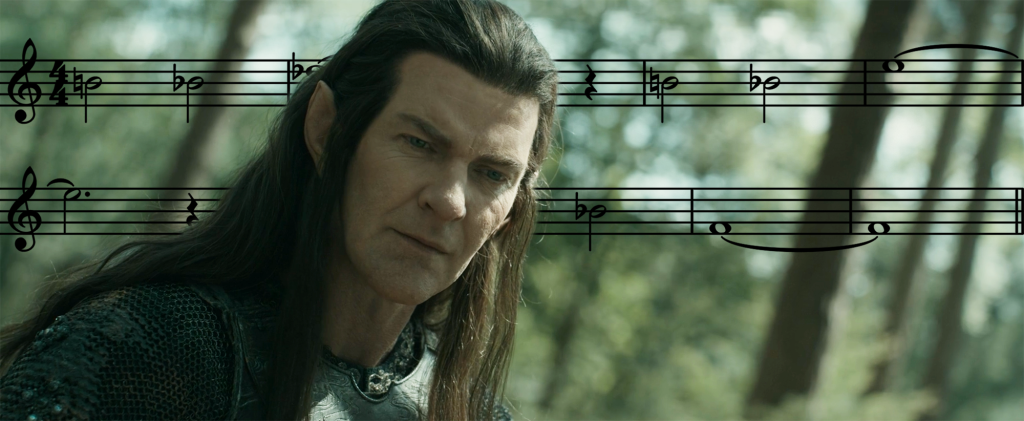
Galadriel, having turned herself in to save her Elven companions, is marched before Adar, heralded by a solo French horn playing her theme. To the shock of both Galadriel and the audience, Adar now wears Nenya, her Ring of Power, upon his finger. His physical scars, the result of years of torment, have been healed: he looks like an Elf for the first time in thousands of years. His signature woodwind instrument, the Middle Eastern ney, whispers a heartfelt rendition of his melody, supported by angelic female choir and new, uplifting harmonies. I strove to give his theme an Elven quality and strip away any dissonances or instruments indicating Orc culture. This is what his theme might have sounded like before his corruption.
Wearing the ring has altered Adar’s perspective on their conflict. He proposes an alliance so they can defeat Sauron together. Overcome with shock and guilt, Galadriel defiantly reminds him that she has killed more of his soldiers, his “children,” than anyone. Her theme here is stated by a regal French horn that represents her nobility, and perhaps remorse, while also doubled an octave higher by a solo flute, bringing to mind her innocent days in Valinor. This musical duality informs the audience that she is drawing on her complete life experience to make the decision that comes next. Harmonic tension resolves suddenly into a beautiful texture when Adar forgives her. One of the things I love about scoring The Rings of Power is that even simply staged dialogue scenes are laced with subtextual nuance, giving me the opportunity to score them as if they were complex ballets. As Galadriel gratefully receives her ring from Adar, the choir swells an uplifting chord with the Quenya word “Rehtië,” meaning “Salvation.”
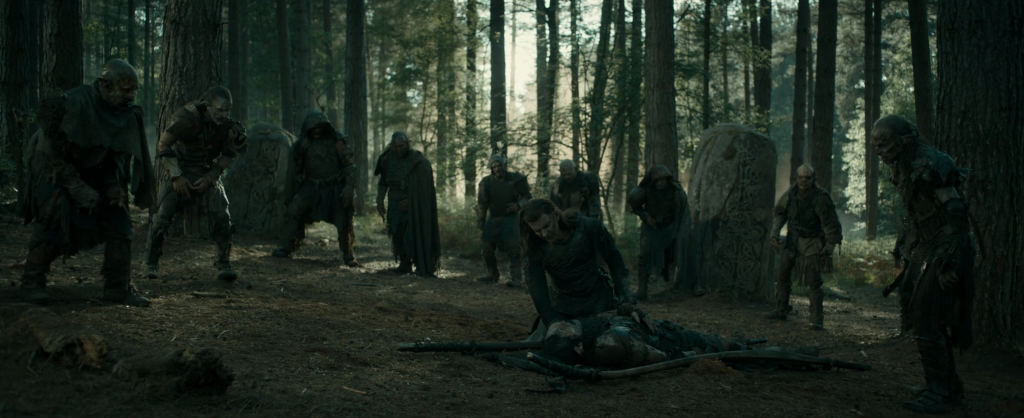
Approaching footsteps steal Adar’s attention. Foreboding celli and basses sigh a heavy quotation of the Adar theme as his soldiers carry his lieutenant, Glûg, critically injured by Sauron, or so he is told by his soldiers. When Adar pleads for Glûg’s forgiveness, his theme returns to the score, again in his signature solo ney. However, this quotation is less pure and idealized than the one from moments ago. Here, there are no angelic choirs or heavenly chords. Instead, the ney is doubled by string harmonics that create dissonance against the woodwind instrument. A subtle dissonance in the music suggests something is amiss. The eerie rendition of Adar’s theme evaporates into silence for a split second before the audience sees the blade in Glûg’s hand. I hoped that this decision made sonic space for audiences to hear themselves gasp in living rooms around the world!

“It’s too late.” With these grim words, Glûg stabs Adar with a rusty blade, revealing he was not wounded at all, and had conspired with his fellow soldiers and Sauron against Adar. Glûg has been played with fascinating pathos by veteran character actor Robert Strange, portrayed first as a loyal henchman, and then with increasing agency, curiosity, and resilience. Robert’s performance, in combination with the prosthetics from our show’s world-class makeup team, made this moment not only shocking, but heart-wrenchingly tragic.
Orcs encircle Adar and stab him mercilessly, mirroring the Shakespearean betrayal against Sauron that Adar himself instigated in the season premiere. Here, music floods back into the soundtrack, where strings play an emotional lament. Actor Sam Hazeldine brought depth to Adar this season, and wanted to ensure his final scene was underscored with a respectful funeral dirge. I will miss writing music for this character in the future.
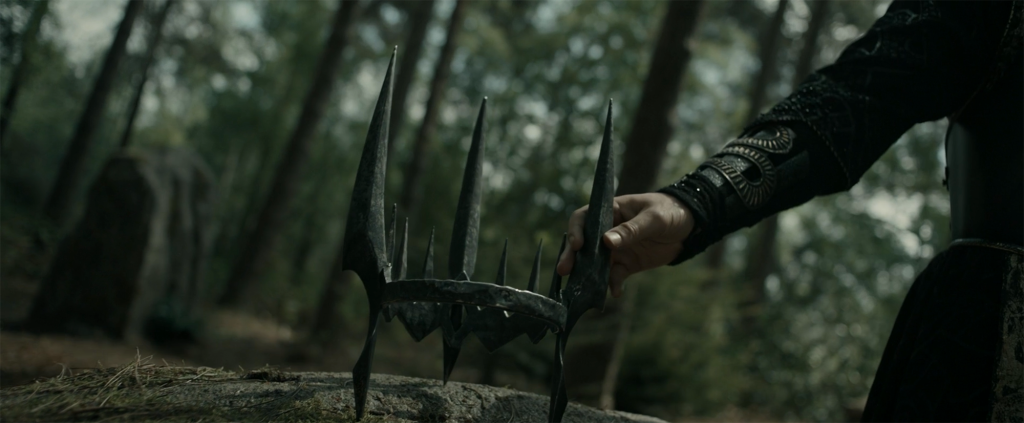
Behind a stunned Galadriel, Sauron emerges to grasp Morgoth’s Crown, while the score reels with the Sauron theme. Low male singers proclaim a menacing Quenya text, “Warme mornië, ulko-kendele,” meaning “Betrayal, darkness, the face of evil.” He strolls over to the Orcs and stands over Adar, as life leaves his body. Here, a final statement of the Adar theme floats in orchestral violins above the airy, even heavenly, sopranos and altos, who sing a pastoral final statement of this melody. Despite the beauty of the phrase, the women offer an ironic text, singing a lament to Adar with the same Black Speech words his soldiers have chanted under his command. “Nampat, ushtha-ish hul-agda u búrzum” means “Death, in flames they return to darkness.”
THE LAST TEMPTATION
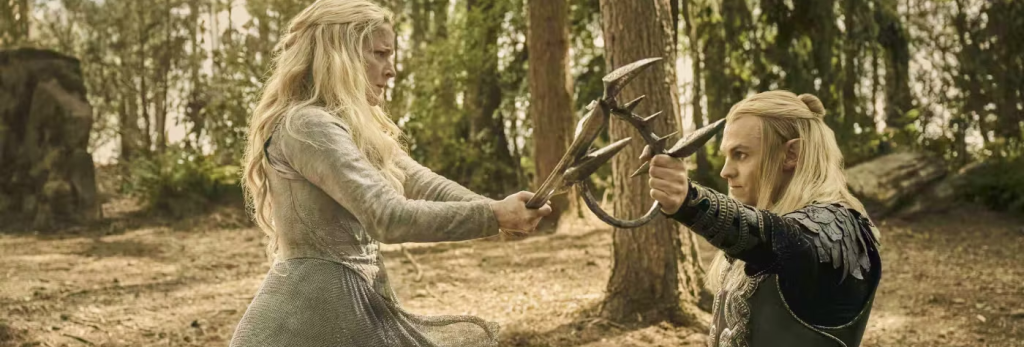
Now in control of an army for the first time in thousands of years, Sauron commands his Orcs to raze Eregion, as his urgent string ostinato revs up. His soldiers race away, leaving Sauron and Galadriel alone, in an ominous fog of atonal orchestral colors, against which the trombones growl a menacing statement of Sauron’s theme, taunting Galadriel, urging her to strike. A vicious swordfight erupts, propelled by a new musical idea, built from pounding drums, insistent marcato strings, and distinctive chanting from female choirs.
I don’t think of this material as a theme, but more like a unique musical canvas, occurring only in one set piece, upon which I could paint variations of familiar themes. In cinema, particularly genre films, this technique of crafting a memorable idea for a single set piece can be found frequently, especially in the works of Danny Elfman (“First Confrontation” from Batman), Basil Poledouris (“Riders of Doom” from Conan the Barbarian), and Jerry Goldsmith (“Pot Luck” from Gremlins II). The true titan in this particular field is maestro John Williams. His examples are too numerous to list, but for a brief sampling, check out “The Asteroid Field” from The Empire Strikes Back, “Scherzo for Motorcycle and Orchestra” from The Last Crusade, “Spyders” from Minority Report, and perhaps the most successful, “Duel of the Fates” from The Phantom Menace.

This season, I had increased the impact of the male chanting by recording two choirs. I thought I would try the same approach here with the female choirs. I combined the sopranos and altos from our Vienna’s Synchron Stage Choir with our Bulgarian women’s choir, the Mystery of the Bulgarian Voices. With each ensemble bringing their distinct experience and cultural background to the sound, they combined to provide a percussive, adrenaline-pumping energy. The distinctly female sound helps empower Galadriel with authority, compelling her to succeed against a cunning and powerful enemy. The two choirs cheer for her with a heroic text.
Quenya:
Maranweo mahtie, ambarto maikar,
Kala pá i more.
English:
Fight of destiny, blades of fate,
Light against the darkness.
As their battle rages, the story returns to the city below as a sorrowful lament of the Eregion theme wails from the orchestra. With the Quenya words “Ilvanië sis,” the choir quotes Círdan’s prophetic words, “Perfection is here,” from the season premiere, laced with bitter irony. As Orc marauders rip down the statue of Celebrimbor’s legendary grandfather Fëanor, the ominous drums of the Orcs theme rumble. (I have historically referred to this particular march rhythm, and its accompanying bone flutes and war horns, as Adar’s theme, but now that Adar has been supplanted, I will just call this march the Orcs theme henceforth.)
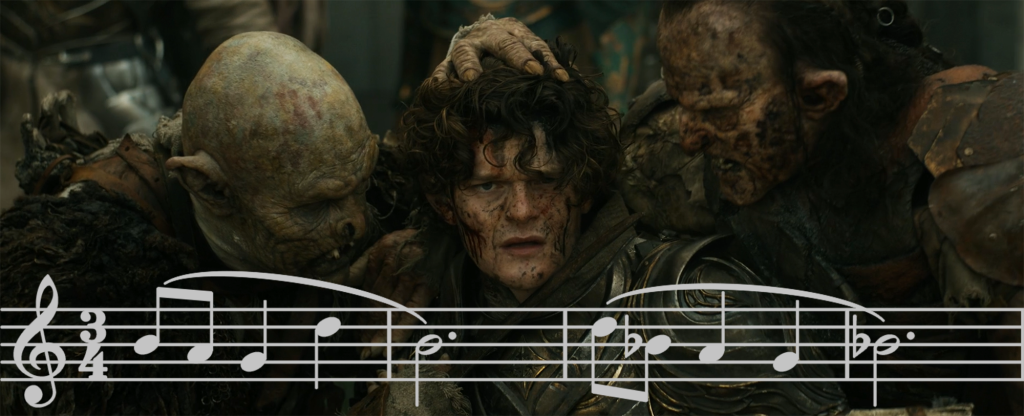
Though Elrond pleads with the Orcs, he is unable to save precious scrolls documenting Celebrimbor’s life’s work. French horns mourn the loss with a lament of Elrond’s theme, as he witnesses the legacy and collected wisdom of Eregion turning to ash.
Meanwhile, atop the cliffs above the city, Galadriel and Sauron continue to exchange blows. Twin female choirs urge Galadriel onward with a heroic text, as the propulsive “Last Temptation” ostinato bursts into the soundtrack once again.
Quenya:
Maranweo mahtie, kendele mitya morilyanna.
Fai hirie kala mo mauye tenya mornie.
Sinwa söa, i mitya more.
English:
Fight of destiny, facing your inner darkness.
Before finding light one must touch the darkness.
Inevitable corruption, the darkness within.
Sauron backs her against stone, and tries to weave his way into her mind once more with his words. His melody is whispered here by child soprano Juno Goode, with the Quenya text “Níri lá naxa,” meaning “Forces beyond evil.” Deep choral men answer in response, swelling with the Rings theme chords, carrying the text “Oia kala ar morë,” a Quenya phrase meaning “Eternal light and darkness.” Resisting him with newfound energy, Galadriel kicks Sauron down as French horns triumphantly declare her theme.
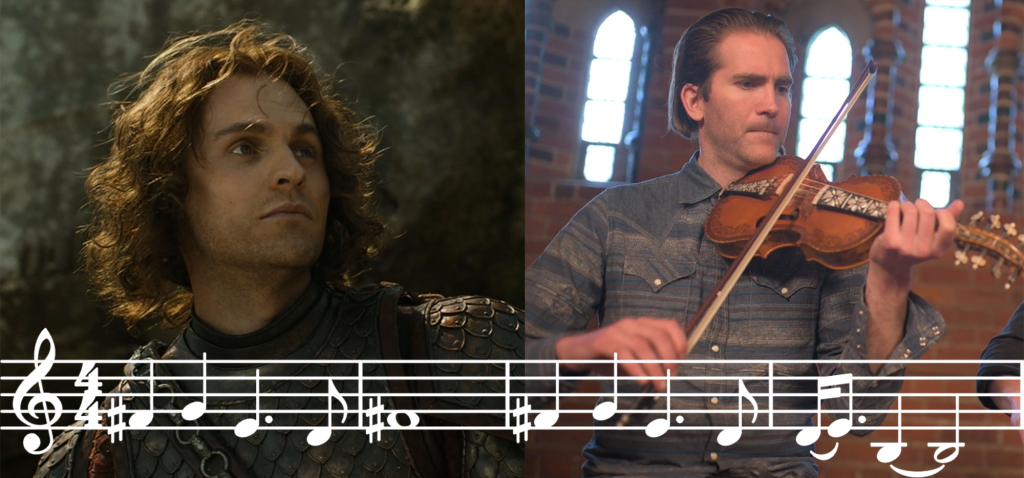
Sauron shocks her and suddenly rises, taking the fair form of Halbrand, bearing his kingly armor from season one’s “Udûn.” Here, Olav Luksengård Mjelva’s Hardanger fiddle returns prominently to the forefront of the score for the first time since the revelation of Halbrand’s true identity in the first season finale. I hope this warm Nordic color on this familiar melody elicits in the audience the same painful sting of bittersweet nostalgia that Galadriel feels.
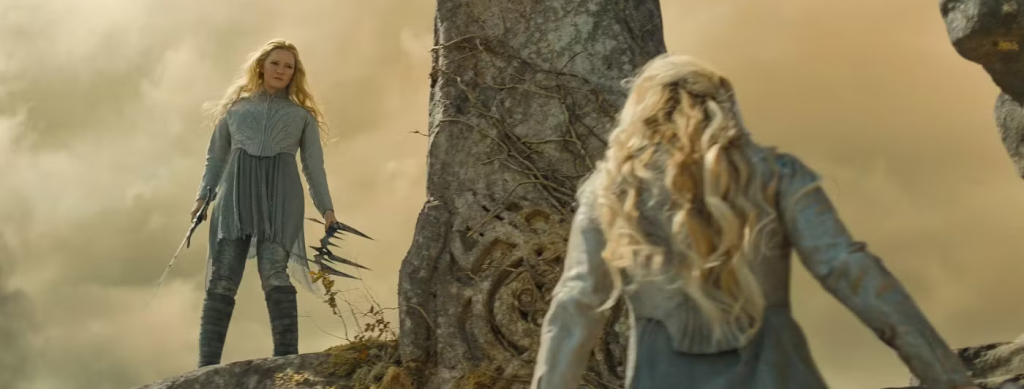
Sauron morphs into Galadriel herself, while orchestral celli evoke the Galadriel theme, altered with the same, sickly diminished tones that infected the Khazad-dûm theme while the king was under Sauron’s malicious influence. Atop the stony ruins, Galadriel fights a twisted version of herself, as singers chant, “Kendele mitya morilyanna, i mitya more,” meaning “Facing your inner darkness, the darkness within.” Starting here, I added male singers to the chanting women an octave below to create an even more aggressive sound.
Transforming once again, Sauron takes the shape of Celebrimbor to taunt Galadriel further. French horns tease her with a terrifying fanfare of the Rings theme, before the rocky ruins collapse and Galadriel hits the dirt below, stunned. Sauron prowls around her, while low male singers proudly proclaim his theme with a Black Speech text, “Burzum kurgrimpat, burzum ozguyat,” meaning “Darkness encroaching, darkness spreading.” Mustering all her strength, Galadriel erupts into a blitz of blades. A triumphant fanfare of her theme propels her, as the various choirs cheer for her.
Quenya:
Maranweo mahtie, kala pá i mornie.
Ambarto maikar, kala pá i more.
English:
Fight of destiny, light against the darkness.
Blades of fate, light against the darkness.
As the two combatants approach the stone ruins at the edge of the cliff, the score takes on a climactic, operatic tone. As strings climb upwards, the choir proclaims, “Victory favors the brave,” with the Quenya text, “Túre listya i neremor.”

Galadriel scores a hit to Sauron’s cheek! As his flesh opens, the orchestra and choir cry to the heavens with a mighty rendition of the Elven Valor theme, using Celebrimbor’s wise words to taunt Sauron. “Lá melehte i ture mornie, apa kala” in Quenya means “It is not strength that overcomes darkness, but light.” A furious Sauron charges, impaling Galadriel to the rock wall with the spiked ends of Morgoth’s Crown.
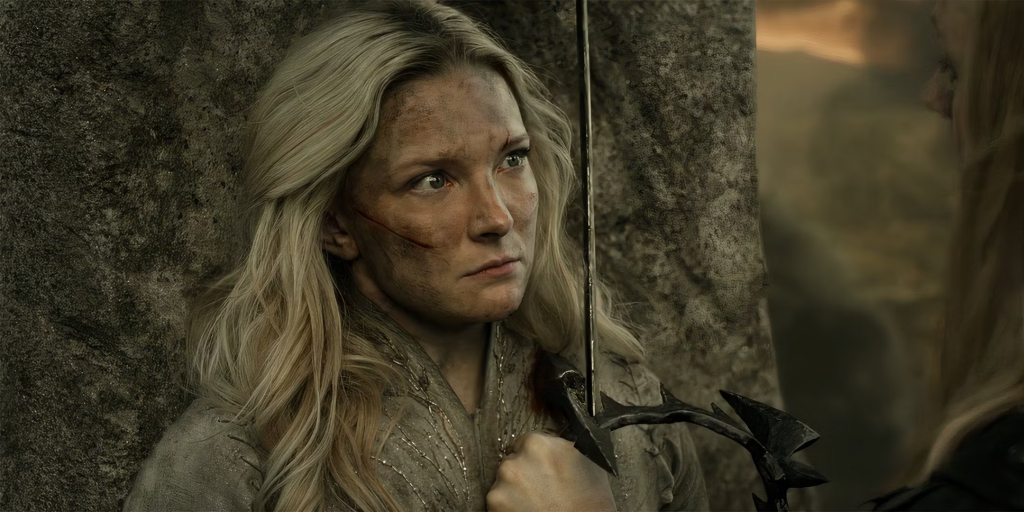
The score grinds to a halt, reduced to a single, quivering high string harmonic. Just as child soprano Juno Goode sang a haunting rendition of the Sauron theme when he was stabbed by this very crown at the dawn of the Second Age, so too does she return here, singing the Quenya text “Ríe anyára,” meaning “Ancient crown.” French horns rally behind Galadriel, replying to Sauron’s menace with a heroic rendition of her theme as she defies him, even on the edge of death. Choral men embolden her with the Quenya text “Kala tauva, nírmië,” meaning “Light endures, determination.” Galadriel collapses to the ground, and Sauron looks down at her, pitiless. Deep brass and low male singers anthemically declare his theme, with the Black Speech text “Burzum-ish duthmak, burzumkoz durbol,” meaning “Reborn in darkness, the Dark Lord.”

To their surprise, war horns suddenly echo from the valley below as Dwarven soldiers charge into the city. The score heralds their arrival with a brassy rendition of the Khazad-dûm theme, as they let loose arrows, allowing Gil-galad, Elrond, and Arondir to break free and attack their captors.
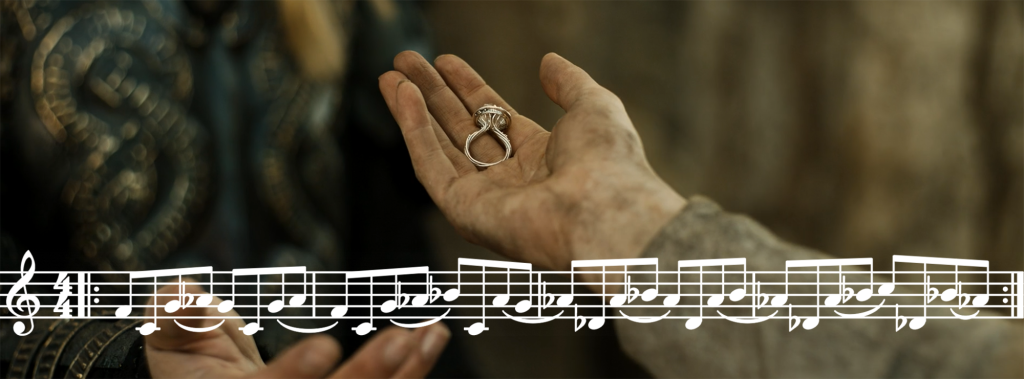
Atop the cliff, Sauron summons his magic, both supernatural and psychological, to entice a dying Galadriel to hand over Nenya, her Ring of Power. The soundtrack surges with the swirling strings of the Galadriel ostinato as she rises slowly before him, as if entranced, while trombones quietly growl the Sauron theme. Hypnotic drones of voices and bell tones take over the soundtrack, signifying Sauron’s mind-control powers, as he commands her once more. Sopranos and altos amplify his demand with words of temptation in Quenya, “Elmenya túre. Oialëa rehtië,” meaning “Wondrous power. Eternal salvation.” (Even the choir is seemingly complicit in Sauron’s lies!) Rather than succumb to him, Galadriel flings herself from the cliff. Here, the orchestra explodes into a tragic musical waterfall. Swirling strings and ripping woodwinds mimic the air roaring around her body in freefall, while French horns roar to their top register on a tragic refrain of Galadriel’s theme. The choir exclaims in Quenya, “Úsahtië, fintaina indo, nírmië,” meaning “Seduction, deceived mind, determination.”
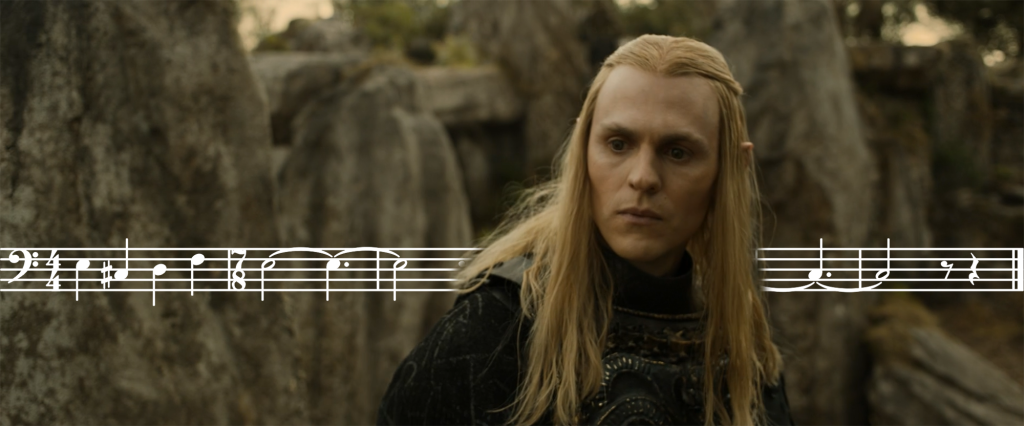
A disappointed but nonetheless victorious Sauron steps back from the precipice, while low male singers anoint him “The Dark Lord” with his melody in Black Speech, “Burzumkoz durbol.” Glûg approaches him with the same honest concern with which he spoke with Adar, only to be unceremoniously rewarded with a blade through his gurgling throat. The season’s final statement of the Sauron theme is whispered in high string harmonics after Glûg’s body falls into the dirt.
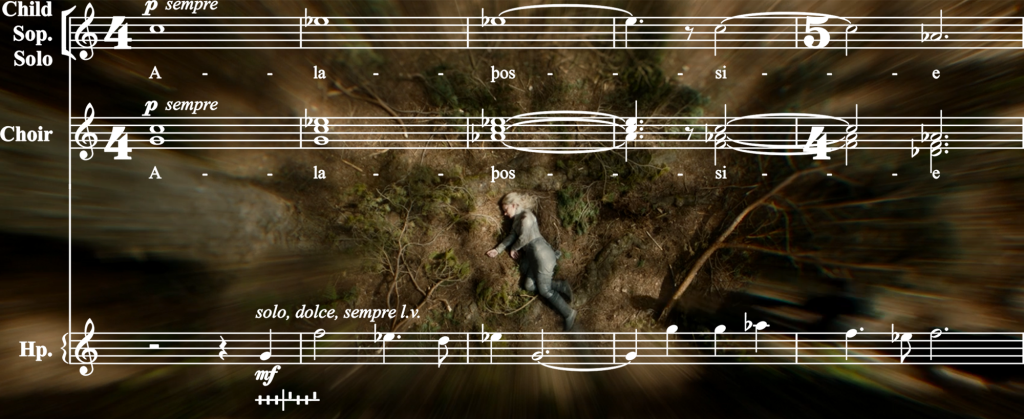
Galadriel lies in a crumpled heap at the base of the cliff, while female singers and children’s choir echo a fragile, funereal chorale using the Quenya text “Alaþossie oia,” meaning “Bravery eternal.” The might of her melody, oft heard in majestic French horns or a lyrical solo flute, is reduced to the singular plucked notes of a solo harp. These notes feel like the musical equivalent of a heart monitor in a modern hospital, slowly beeping while the patient clings to life.
Elrond finds Nenya, Galadriel’s Ring of Power lying in the grass nearby. As the Elf most reticent to trust in the power of the rings, he still recognizes he could use it to save Galadriel’s life. The score swells with a hopeful ostinato of strings churning and the violins pick up the Elrond theme as he places the ring on his finger. His theme has appeared in a solo clarinet to underscore the outcast diplomat and friend of Dwarves in season one, and throughout season two as a mighty brass fanfare for the mud-soaked commander on the battlefield. Now, this new arrangement of the Elrond theme feels more powerful, combining both versions, as he makes a fateful decision to use the power of Celebrimbor’s ring to save his dying friend.
THE STAFF AND THE NAME
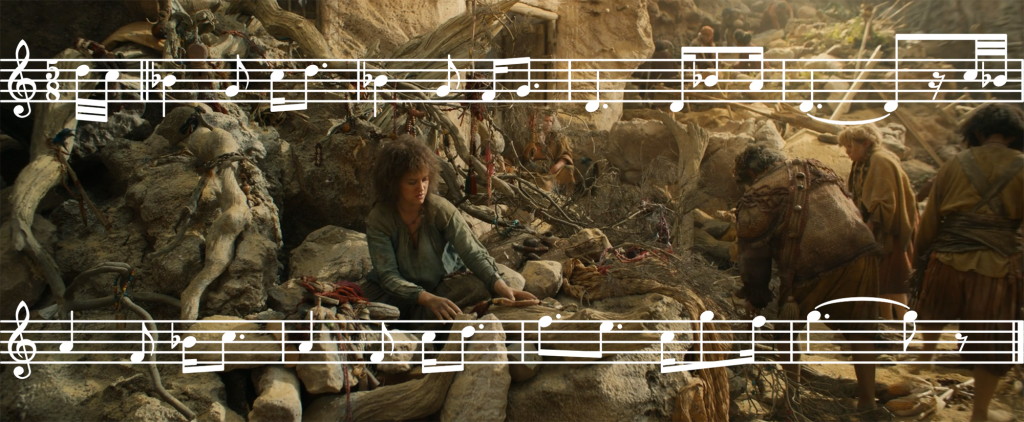
To the east in Rhûn, the halflings gather what they can from the rubble that remains of the Stoors’ village. Paul Cartwright’s lonely solo fiddle plays a lament of the Stoors theme “B section.” Poppy shuffles over to Nori to see crushing guilt written across her face. Eric Rigler’s solo pennywhistle whispers a heartbroken refrain of Nori’s theme.
Poppy offers her words of comfort, painful as they may be. As she speaks of grappling with loss, a montage intercuts images of the series’s primary characters, ranging from the Dwarves to Elrond to the survivors at Pelargir to Númenor, and even to Sauron. Rather than highlighting each character’s moment with a fragment of their theme (an idea I attempted and abandoned, I might add!) I chose instead to unify this montage with a single piece of music. I supported Poppy’s message with a lush quotation of the Elven Hope theme I originally composed for “Doomed to Die” to support Celebrimbor’s words of wisdom to Galadriel. Both scenes are emotionally related, and even fall at similar places in the story structure of each episode. I found unifying them with direct musical quotation to be emotionally impactful.
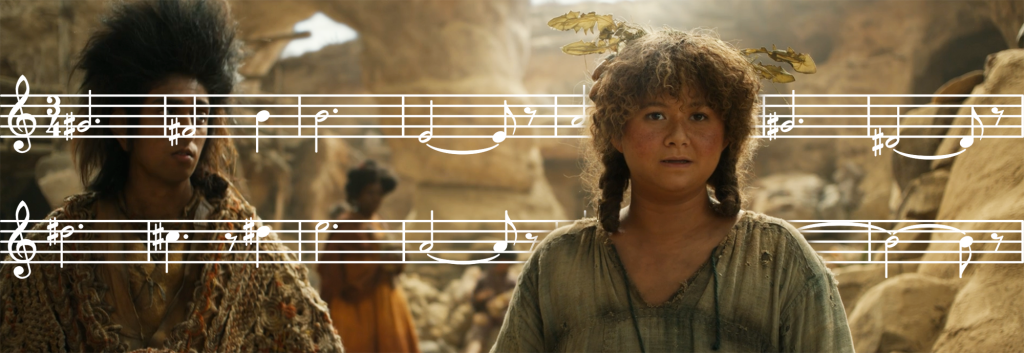
The montage begins with proud celli arpeggios as the Dwarves behold King Durin’s empty throne in Khazad-dûm. (While this is not a direct quotation of the cello arpeggios that accompanied the king’s noble sacrifice in the episode’s opening, it is a spiritual cousin.) Sopranos, altos, and children’s choir enter with the melody of the Elven Hope theme when the audience is shown Celebrimbor’s gorgeous forge tower tumbling, in flames, to the ground. I found the presence of the children’s choir here especially moving, because the ensemble was so often associated with the Eregion theme. The singers support Poppy’s message of hope with a poetic text.
Quenya:
Vanwe engweli vanwe nar oiale.
Loikohtali, ar yávenke turmeli an aranielya.
Estel mi ambar an imle.
Kala tauva, orya ar sila.
English:
Some things lost are lost forever.
Many defeats, and many fruitless victories for your Kingdom.
Faith in fate for yourself.
Light endures, rise forth and shine white.
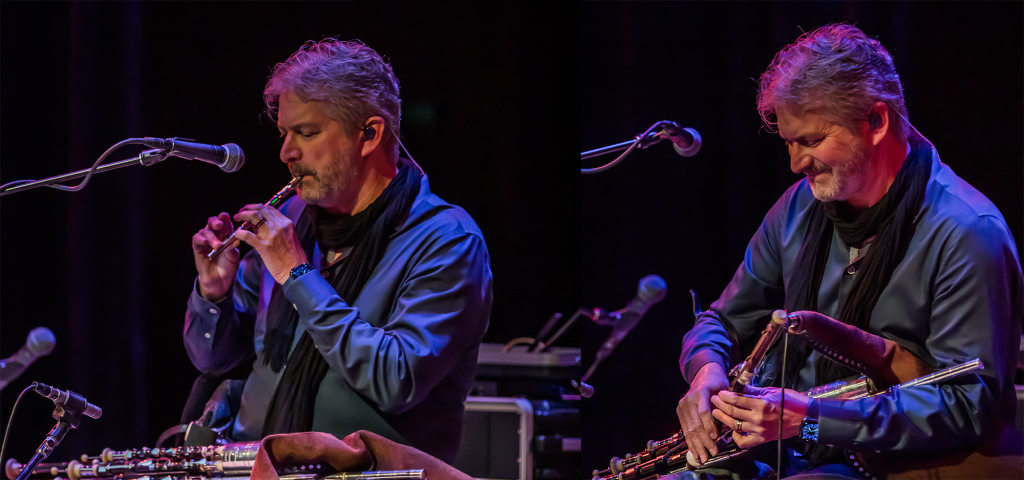
The Harfoots say their farewells to the Stranger as they follow the Stoors on their migratory quest to find a new home. A lone Irish whistle offers a plaintive statement of the Nori theme as she, at last, says goodbye to her friend. As Nori glances back at the Stranger one last time before leaving, the orchestra swells with a lush, final statement of her theme, supported by Eric Rigler playing both uilleann pipes and pennywhistle.
As he leaves, the Stranger nearly trips on an odd branch. The ethereal gamelan tones of his ostinato toll mysteriously as he picks it up, against exciting trilling string harmonies that add electricity to the air. Celli pick up the Stranger theme with lyrical confidence, carrying across the cut to him wandering the wilds of Rhûn, staff in hand, where violins and violas continue his melody with adventurous spirit.

The Stranger wanders back to Tom Bombadil’s hut. Even before anyone has entered, Tom knowingly pours two cups of tea, while rich basses and tenors sing a wordless chorale of the Bombadil theme chords. A solo fiddle opines a wistful statement of “Old Tom Bombadil” as his front door creaks open and the Stranger enters. Here, the Stranger recognizes Bombadil had given him a test: to choose between power and friendship. In a burst of inspiration, his name, at long last, comes to him.
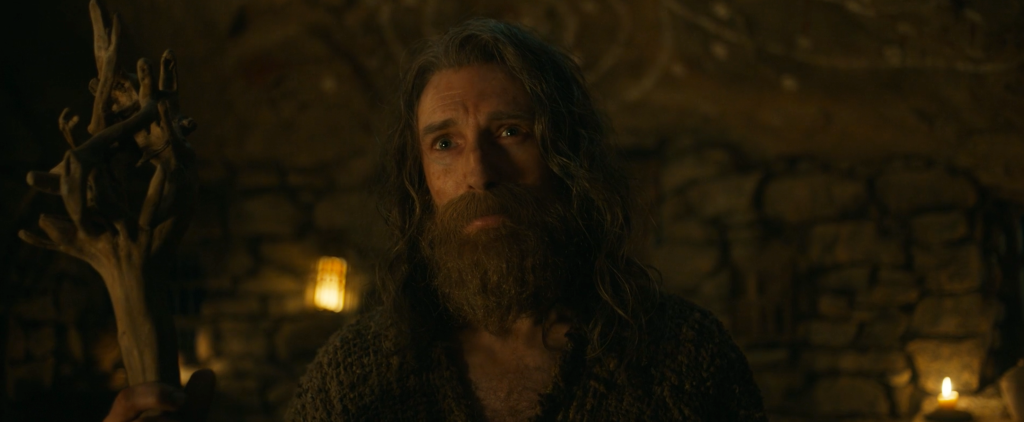
“Gandalf. That’s what they’re going to call me.” With a deep sigh, the Stranger utters these words and with that, he is a Stranger no more. After working on this series for two and a half years, I can finally call his signature music what it really is: the Gandalf theme. (Writing this blog marks the first time I’ve even written the words “Gandalf theme” and I am overcome with excitement and honor.)
Surprisingly, the first piece of music heard after Gandalf pronounces his name is not the Gandalf theme, but fittingly, “Old Tom Bombadil,” sung with earnest warmth by actors Daniel Weyman and Rory Kinnear as Gandalf and Tom sit around the fire. This cozy moment channels the heartfelt spirit of Tolkien’s writing perhaps better than any shot in the series thus far.
Merry dol! derry dol! Ring a ding dillo.
Sandflies in the grass, bees around the willow.
Now let the song begin, let us sing together.
Of sun, stars, moon, and mist, rain, and cloudy weather.
Light on the budding leaf, dew on the feather.
Wind on the open hill, bells on the heather.
Old Tom Bombadil is a merry fellow,
Bright blue his jacket is, and his boots are yellow!
Reeds by the shady pool, lilies on the water,
Old Tom Bombadil, and the River-daughter!
Far away, the Bulgarian women’s choir wails a Rhûnic text soaked in reverb and delay as the Dark Wizard contemplates the future.
Rhûnic:
I Šigór i Lún,
I Lurg i Bauvailun, fú nim-žil.
English:
The Dark Wizard,
The Threat Unseen, under moonlight.
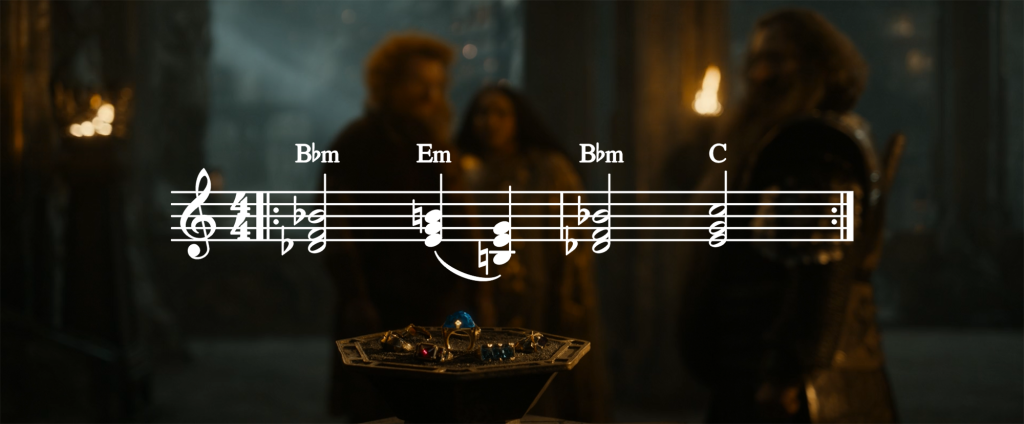
In Khazad-dûm, Navi consults with Durin and Disa, while a cello offers a stoic statement of the Durin theme. Durin tells Narvi to dispatch word to Elrond that they will offer further aid, as a French horn offers a gentle statement of the Khazad-dûm theme, underlining that the son is prepared to step into his father’s place. The theme’s steady ostinato propels forward as Disa and Narvi suggest political complications lie on the horizon, while low trombones repeat the melody with increased gravitas. An eerie quotation of the Rings theme chords lingers in the air as they glance with trepidation to the seven Rings of Power still in their possession.
THE SUN YET SHINES
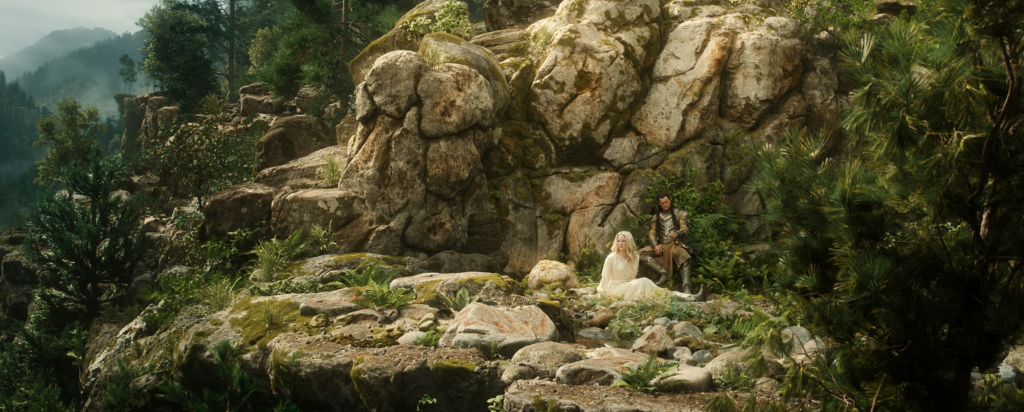
Galadriel awakens as golden rays of sunlight illuminate her face. She turns to see Gil-galad by her side, as a gentle flute solo whispers her theme in an innocent statement reminiscent of her music when the audience met her as a young girl in Valinor in the series premiere. As she beholds her serene surroundings, female singers offer lyrical reassurance with the Quenya words “Sí sérena na, i tiríte kallo,” meaning “Tis now time for rest, the vigilant hero.”

Elrond’s approach is heralded by a regal horn statement of his theme, with warm chords suggesting their conflict has been resolved. They await a decision from High King Gil-galad: Should they attack Sauron’s marauding forces as he spreads across Middle-earth, or fall back to a defensive position in Lindon? Galadriel reminds them of the counsel of Celebrimbor, “It is not strength that overcomes darkness, but light,” as the orchestral strings churn with her emotional ostinato. Sopranos and altos echo her words in lyrics.
Quenya:
Lá melehte i ture lóme, mal kala.
Kala tauva, ilya mornie rukuva.
Illume queni nar i oryar ar kalir.
English:
It is not strength that overcomes darkness, but light.
Light endures, all darkness must flee.
There are always some who rise forth and shine.
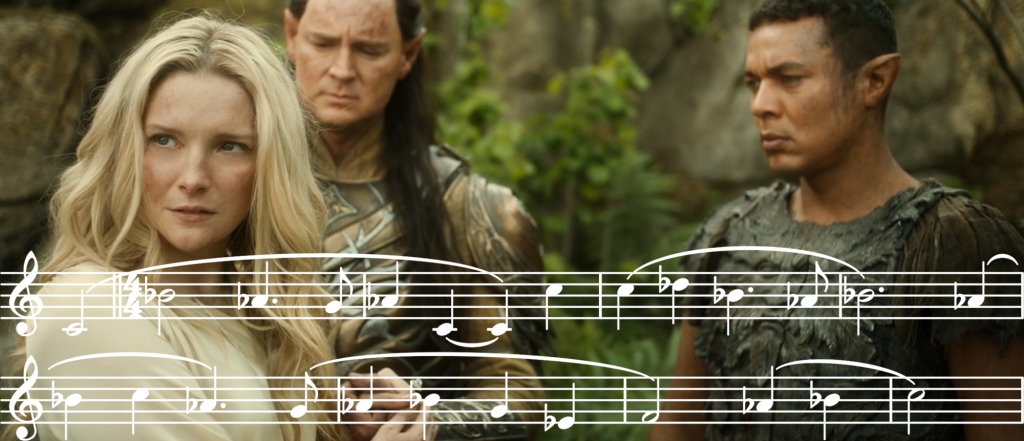
“And the sun yet shines.” With these words, Galadriel makes her intention clear. Together, Gil-galad, Galadriel, Elrond, and Arondir walk to the edge of the cliff, to which the surviving elves of Eregion and Lindon in the valley below look for answers. The final note of Galadriel’s melody reduces to a single sustained pitch that hangs in the air with bated breath.
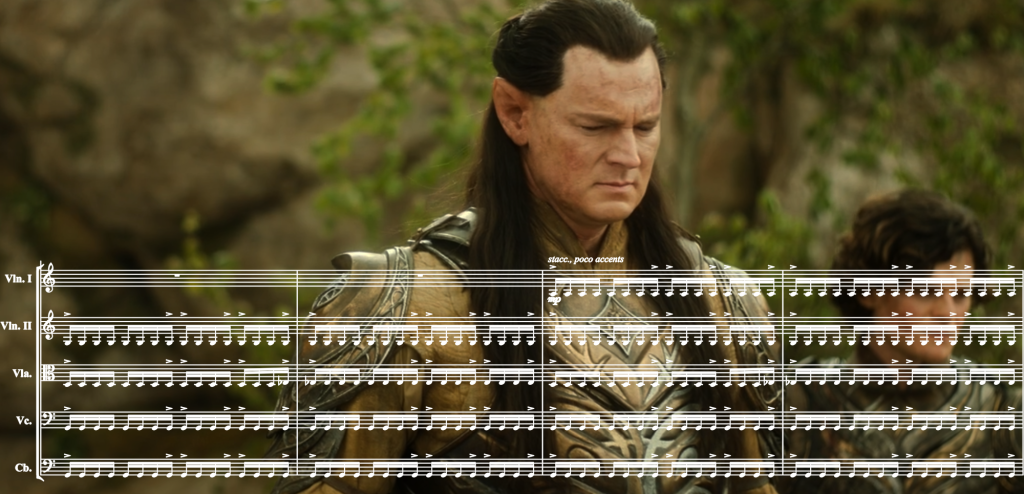
Gil-galad steps forward, and a new, propulsive string ostinato engages. The Elven Valor theme, now imbued with promise and passion, enters from the male singers.
Quenya:
I rahtie turmeno máraléva landenka,
Aumenta úmarta mina mornie.
I láma máraleo yaliéva funduna.
Kala sile mettalenka!
English:
The reach of virtue’s realm is boundless,
Banish misfortune into darkness.
The sound of virtue’s call is thunderous.
Hope flickers endless!
Unsheathing his blade, Gil-galad holds it aloft in defiance of Sauron’s treachery. The survivors cheer as the orchestration expands dramatically. Strings leap to their upper registers as the female singers join their male counterparts in the Elven Valor theme’s second half. A season of television that dealt with relentlessly dark themes of deception and loss smashes to its final end credits on an image of hope, energized by music that promises righteous battle to come.
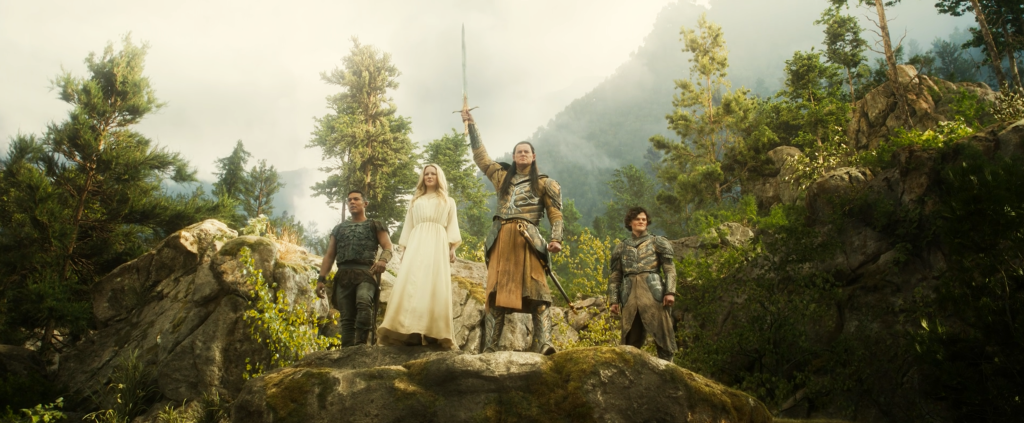
I continued this new variation of the Elven Valor theme for the end credits to “Shadow and Flame,” intertwining it with Galadriel’s theme. I hoped to create something memorable, epic, and triumphant. I also incorporated the percussive vocal shouting of “Last Temptation.” As trumpets and horns proudly proclaim the Galadriel theme, a choir chants a heroic text.
Quenya:
Maranweo mahtie, kala pá i lóme.
Mitya lóme i Ambarto maikar.
Fai hirie kala,
Mo mauye tenya lóme, i mitya Mornie.
íre lóme lanta, kala sile.
English:
Fight of destiny, light against the Darkness.
Darkness within the Blades of fate.
Before finding the light,
One must touch the darkness, the Darkness within.
When darkness falls, light shines.

After the Galadriel theme has made its mark, the Elven Valor theme returns, with a mighty lyric from the choir.
Quenya:
À mahta tenna félda an i mihamnielyet,
Lan kiryastal’ ambarto sólainen.
Ilye nati teluvar, mornië kalan lúta.
Lúme nore oiale póna, ar Anar tensi kale.
Ambar ná apataina yasse lumbuler kaitar!
English:
Fight until your last breath for those you have buried,
While sailing with the tides of fate.
All things must end, darkness swims to the light.
Time gallops ever forward, and the Sun yet shines.
Fate has been revealed where the shadows lie!
For me, “The Sun Yet Shines” represents something bigger than the end credits to an episode of television; it is a major milestone in my creative life. Last season, I struggled to get to the finish line creatively without also sacrificing essentially everything else in my life: my family life, personal mental health, and physical health. I knew this was unsustainable. For season two, I vowed to balance these needs more thoughtfully. I was exhausted by the end of “Shadow and Flame,” and completed the last cue mere hours before boarding a plane to London to conduct orchestral recording and do press for the show. However, I also reflected on how I had been nevertheless successful in keeping my life in better balance during my creative process for season two than ever before. For me, writing this expansive end credits piece was a metaphorical victory lap to commemorate that success. I felt victorious, like Gil-galad himself in the episode’s closing frame.
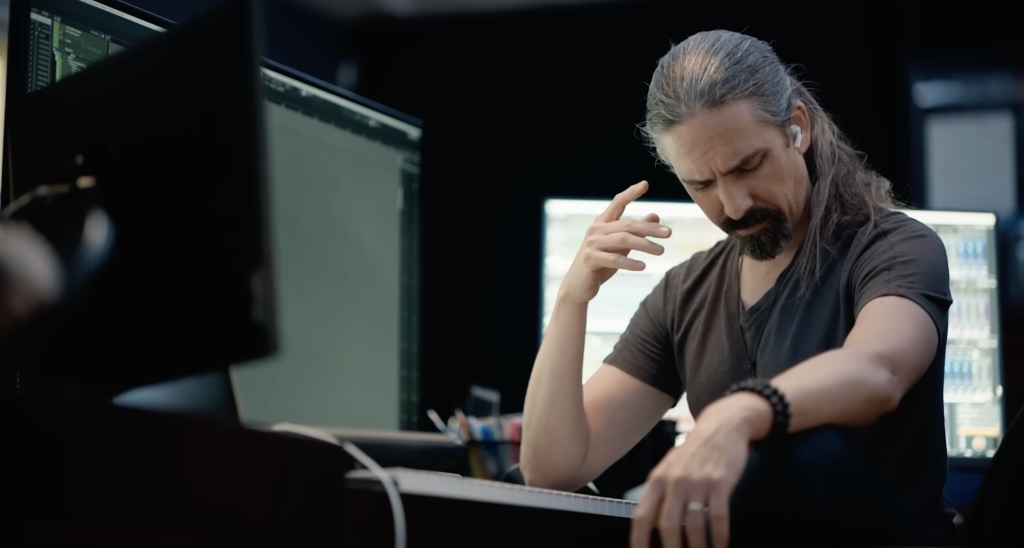
As ever, I am grateful to all of you for watching our show, for listening to my music, for taking part in positive discourse online, and especially for taking the time to read my mammoth blog entries! I am always thrilled to find like-minded people who delight in the details of music written for media as much as I do. And with that, my work on the second season of The Rings of Power is complete. For now, it’s time to hang up my bright blue jacket and yellow boots until they become necessary once again.
—Bear