

In this series of blogs, I explore the detailed musical depths of The Lord of the Rings: The Rings of Power. For a comprehensive look at my score for the series, explore my previous blog entries here, and check out the soundtrack albums (a compilation for each season and a comprehensive album for each episode) available on all platforms.
SCORING EPISODE 203
“THE EAGLE AND THE SCEPTRE”

This episode gave me an opportunity to compose new themes, including for characters such as the Southlander Estrid, Damrod the hill-troll, and one of Tolkien’s most legendary creatures, the malevolent spider-like creature Shelob. The narrative also explores the political crisis of the Númenóreans, the further adventures of Isildur, Arondir, and Theo, as well as the Dwarves of Khazad-dûm as they grapple with their grim dilemma.
THE WEB OF SHELOB
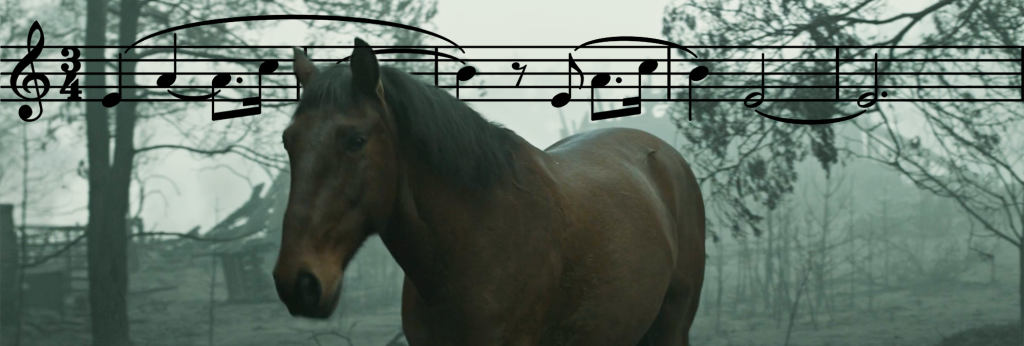
SPOILERS AHEAD: At the end of the first season’s seventh episode, we saw the faithful horse, Berek, charging back into the burning wilds of Mordor, seeking Isildur, who is lost and presumed by his father, Elendil, to be dead. The audience hears a heartbreaking variation of the Faithful theme, music most closely allied to Elendil and his son Isildur. Berek picks up Isildur’s trail, leading to a dark cave in the mountains. The Faithful theme returns in a regal French horn solo as the horse finally reunites with Isildur, played by a charmingly scrappy Maxim Baldry.
Their tender reunion sours as Isildur gathers enough consciousness to survey his surroundings— he is webbed to a wall, surrounded by thousands of oily black eggs. Tension ratchets up furiously, as the sequence, directed confidently by Louise Hooper,escalates. A black egg bursts open, and eight tendrilous legs emerge. Here, the score crawls with my Shelob theme.

This theme is an obvious musical metaphor for spiders. I represented the eight legs of a spider with repeated gestures of eight notes in pizzicato orchestral strings. When a string player plucks a string, their hands look similar to spiders extending their limbs along a web. If one could look at the orchestra performing this theme, it would bear a striking visual similarity to a sea of spiders—symphonic arachnids!
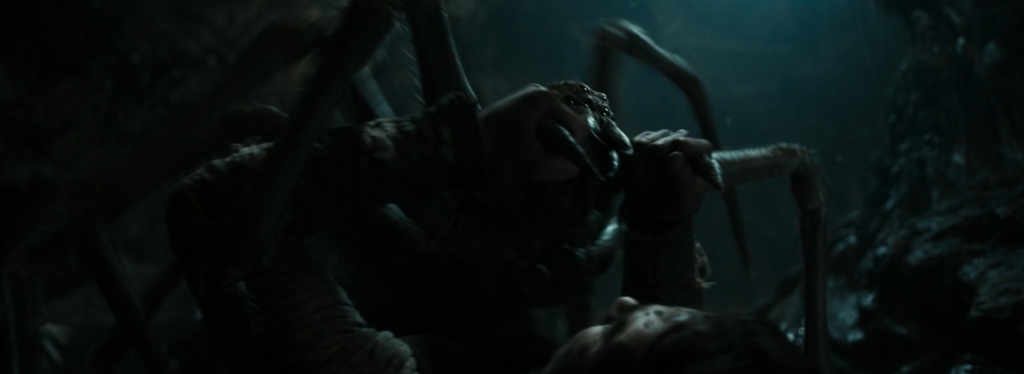
As the cave teems with spiders, this repeating eight-note pattern gets louder and louder. At last, one spider, larger than the rest, emerges: Shelob. For her, I added new layers of snarling low brass clusters, evoking the roars of a mighty beast. At the climax, the choir aggressively chants in the Tolkienian language of Quenya the words “Rembina farna, ungwe, hloima!,” meaning “Woven prey, spider’s web, poison!”
I was honored to have the opportunity to write a theme for one of Tolkien’s most fearsome creatures!
TO NÚMENOR
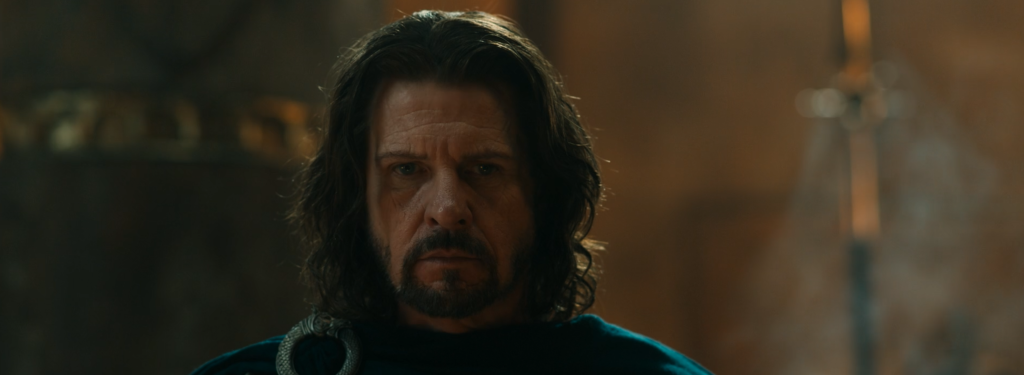
The story returns to the island kingdom of Númenor, the people gathered for the king’s funeral. As Elendil mourns the losses of his family and his nation, he struggles to connect with his daughter Eärien. His pain is augmented by a mournful solo harp echoing the notes of the Faithful theme.
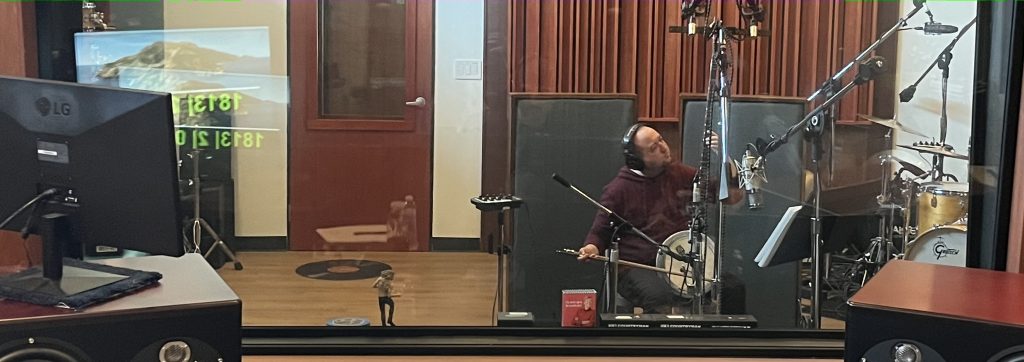
At the call of distant horns, the Faithful theme is overtaken by a powerful march of frame drums heralding the Númenor theme, carried proudly by mighty brass˜. The melody is also supported by a trio of soloists that have always represented Númenórean culture: the Turkish yaylı tanbur played by Malachai Komanoff Bandy, solo cello played by Eric Byers, and Armenian duduk played by Chris Bleth.
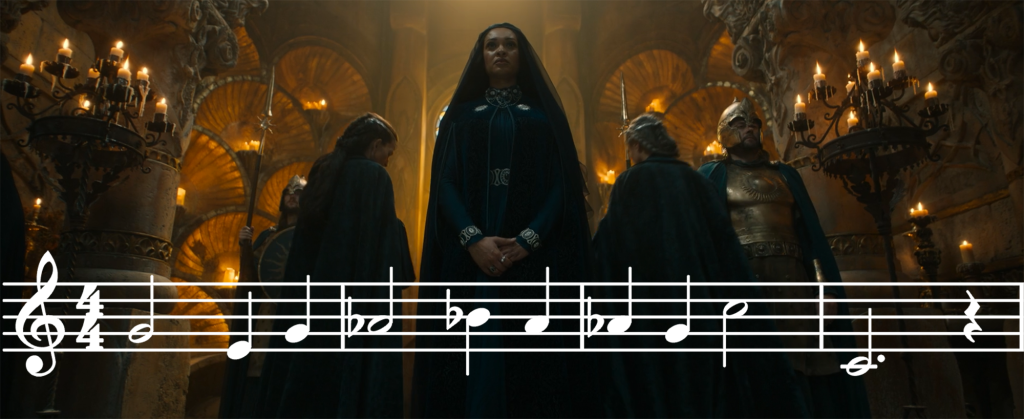
Queen-Regent Míriel, still blinded from the events in the Southlands, enters to pay her respects. For her scene here, the Númenor theme retains its beauty from last season. But savor this feeling. The harmonic and melodic phrasing of the Númenor theme will become increasingly minor and discordant over this season. (More on that later.)
To the shock of the assembly, a weeping mother accosts and slaps Míriel. Before the situation escalates, Míriel demonstrates her empathy and embraces the grieving woman. Here, a haunting vocal solo is carried by Raya Yarbrough, who has made frequent contributions to the series’s score.
In a later scene, Eärien tells Pharazôn about how she discovered the palantir, an Elven Seeing-stone, in a hidden chamber in the King’s tower. Mimicking her words, the chords swell with foreboding sentiment, sung in Tolkien’s native Númenórean language of Adûnaic.
Adûnaic:
Urkūna. Babēthān. Dolgu.
Ilmā urkūna, ilmā dolgu.
English:
Dangerous. Forbidden. Secret.
Something dangerous, something secret.

ENTER DAMROD
Meanwhile, in Mordor, a new vocalist makes a surprising entrance into the sonic world of The Lord of the Rings. As Adar and his legions prepare for war, they are visited by a massive hill-troll named Damrod. As he approaches, his theme is screamed by a phalanx of angry male vocals, with one voice in particular rising above the rest. Extreme heavy metal fans will instantly recognize the voice of Jens Kidman, lead singer of the Grammy-nominated åband Meshuggah.
I had worked with Jens closely, on the song “Roko’s Basilisk” from my debut rock record The Singularity, which launched in May 2024. That collaboration inspired me to bring him with me to Middle-earth!

The idea to give Damrod his own metal-influenced theme song did not strike me until I was deep in the throes of scoring the seventh episode of this season, where he is a terrifying presence. By that time, recording and mixing for the third episode had long since been completed. Undeterred, I asked the show’s postproduction crew if it were still possible to wedge in one last cue before the third episode was delivered. Though difficult, the producers were excited to introduce Jens Kidman’s voice in Damrod’s entrance. At the last minute, I wrote a cue for this scene, built from the material I was writing for him in the seventh episode. We fast-tracked all the recording sessions for this cue, and managed to get it over to the dub stage in time for the final delivery.
I was thrilled to bring Jens into The Lord of the Rings. I will have much more to say about our collaboration in a future blog entry.
NEGOTIATING WITH DWARVES
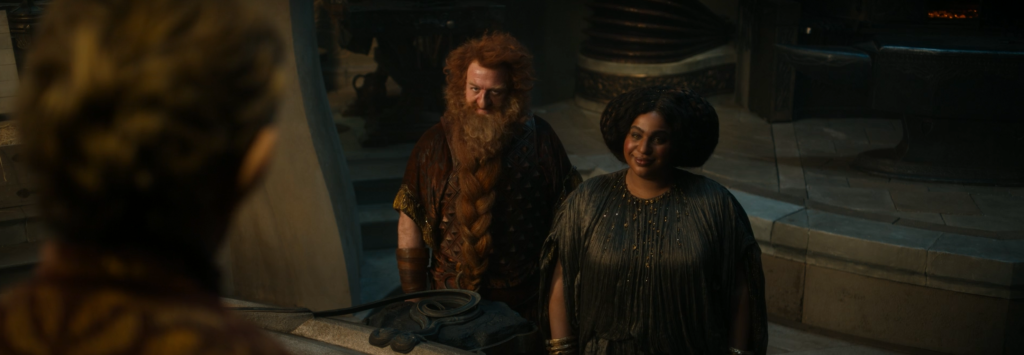
Durin and Disa arrive in Ergeion at Celebrimbor’s invitation, where he proposes an exchange in which the Dwarves receive Rings of Power in trade for the rare mithril required for their creation. The tense scene, punctuated with moments of surprising humor and wit, is underscored with mysterious quotations of the Rings theme chords and the Rings theme.
Making his appeal, Celebrimbor assures Durin, the Prince of the Dwarves, that their Rings of Power would grant them power to heal their kingdom. The orchestra supports his case with a luscious variant of “Where the Shadows Lie.” The mysterious melody is still the same, but the harmonies around it have changed, carrying a completely different emotional message. This uniquely warm, new variation of this theme represents Sauron’s desire to forge new rings as presented through Celebrimbor’s positive outlook, which is itself a result of Sauron’s manipulative influence. (As episodes continue, listen for the increasing emotional range of this theme—its variants will alternate with increasingly sweet, and increasingly malicious, settings.)
Annatar emerges from the shadows and offers his name to a skeptical Durin, while the score plays a creepy statement of the Sauron theme, in eerie string harmonics and pitched percussion. Durin looks at Annatar with suspicion, and the score practically screams at him to trust his instincts. The episode’s finale indicates that, ultimately, the Dwarves are swayed by Celebrimbor’s offer.
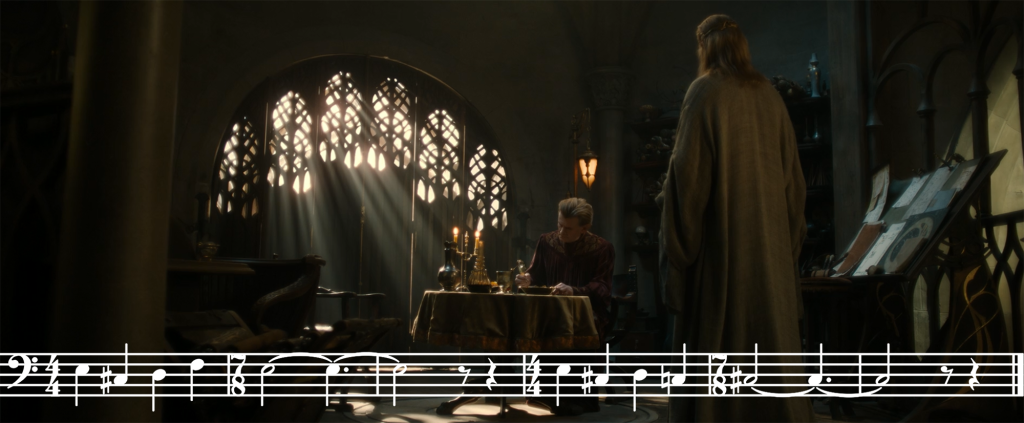
Later, Annatar prowls around Celebrimbor like a wolf might circle an injured rabbit. Low swirling strings bend ominously against foreboding male-choir tones. A ghostly, high statement of the Sauron theme, presented in emotionless, icy string harmonics, underscores Sauron’s glance as he raises his gaze with simmering excitement towards the forge.
ESTRID
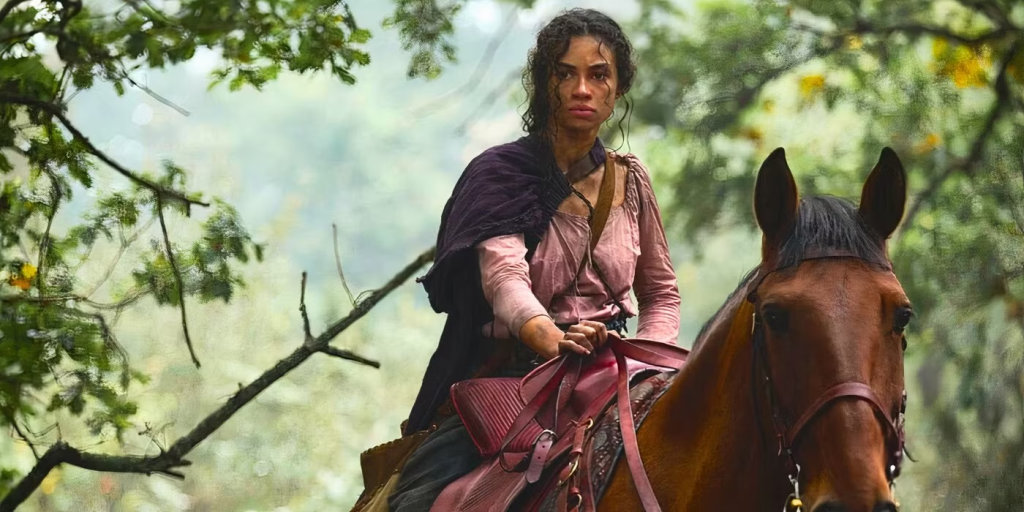
After Isildur escapes Shelob’s lair with Berek’s help, he encounters a woman in the wild named Estrid, played intriguingly by Nia Towle. From her he learns that his fellow Númenóreans who had come to war in the Southlands have already retreated back to their island. Together, Estrid and Isildur make their way towards the old settlement of Pelargir. As they travel, the score introduces the Estrid theme.

Her theme is built over a beautiful chord progression, played as a lilting ostinato on nylon string acoustic guitar by my frequent collaborator Andrew Synowiec, along with gentle hammered dulcimers.

These arpeggiations are similar to the gestures heard in the Faithful theme. I crafted this similarity deliberately so I could find common musical threads with which to weave their themes together as their relationship evolves. This musical connection was particularly helpful later in the episode when Isildur joins Estrid by a fire and they bond over their shared losses. The score there gently sways between their two melodies, connected by their simple guitar arpeggios.

Though Estrid’s ostinato resonates with Númenórean tones, her melody reminds us of her Southlands origins, being featured on Olav Luksengård Mjelva’s Hardanger fiddle. The Southlands theme last season was represented by a Hardanger fiddle and nyckelharpa duet. Even though the region itself is now an ashen wasteland, I felt that by featuring one of those instruments I could help the audience understand Estrid’s backstory. Leaning on Olav’s ability to conjure the beauty of Nordic folk music, I strove to write a theme that might capture an authentic sense of innocence and beauty.
FUNERAL PYRE AT PELARGIR
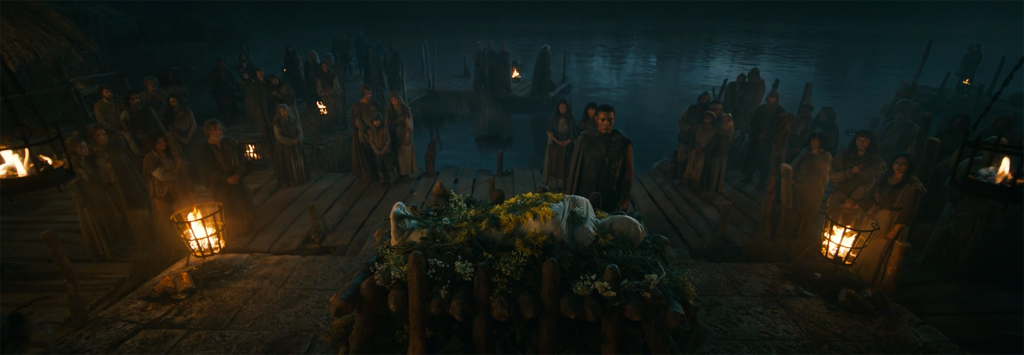
On the road to Pelargir, Estrid and Isildur are attacked by wild men, and Berek is kidnapped in the ensuing chaos. Arondir rushes to their rescue, marking an exhilarating return to the series for the charismatic Ismael Cruz Córdova. Arondir slays their assailants while a heroic brass fanfare blasts a triumphant statement of last season’s theme “Bronwyn and Arondir.” Alas, the theme takes on dark undertones in the next scene, forming the basis for Bronwyn’s funeral dirge.

I scored this funeral sequence with a full statement of the Bronwyn and Arondir theme, sung in a stunning solo by Raya Yarbrough. Her lyrics are a sorrowful lament.
Quenya:
Oialëa enyalier.
á orta menelda, melde.
Naire-naika, naike nier.
Emel koita oiale.
Rakina nosse, litsi.
English:
Eternal memories.
Ascend to the heavens, beloved.
Grief-stricken, anguished tears.
Love lies eternal.
Broken family, ashes.
Raya has frequently lent her voice to The Rings of Power, in particular in several key moments pertaining to Bronwyn. In the sixth episode of season one, her angelic voice supported Bronwyn and her son Theo embracing in the calm before the battle. Then, in the seventh episode, Raya returned once again as Theo approached a body in the medical tent he feared to be his mother.
Here, in season two, Raya’s voice brings forlorn tragedy to this heart-wrenching sequence. After she concludes her first run through the theme, operatic orchestration in strings and brass pick up the melody as Theo ignites the pyre. A musical gesture this massively symphonic requires a sweeping narrative canvas like The Lord of the Rings to allow for its scope and intensity. I found myself getting very emotional as I wrote this track. This music helped me to absorb my own shock that Bronwyn had died, and I hope it could do the same for fans.
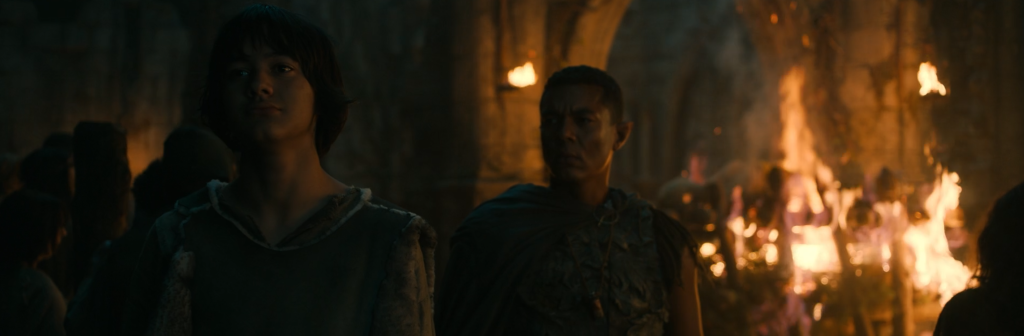
After turning his back on his mother’s burning funeral pyre, Theo clashes with Arondir, as he makes failed attempts to bond with the angry young man. Having none of it, Theo snaps back a painful reminder that Arondir is not his father, while low male voices echo his painful words with an ominous Quenya text, “Litseli. Ilu litsessen,” meaning “Ashes. Everything in ashes.”
Later, Theo agrees to assist Isildur in rescuing his horse Berek from the wild men. In the midst of their rescue attempt, Theo is suddenly caught up in an attack by unseen forces. This sequence is scored with aggressive orchestral horror writing, punctuated by relentless wooden percussion, including log drums, claves, and bamboo sticks. As Theo is whisked off his feet and lifted into the air, an ascending phrase in the choir bursts forth with the Quenya words “Rikila sundor,” meaning “Twisting roots.” (This musical passage has thematic significance I will explore in the next blog entry.)
THE EAGLE AND THE SCEPTRE
The climactic, titular sequence in “The Eagle and the Sceptre” is one of the most narratively complex scenes in the season, bursting with a half dozen major plot twists and revelations.
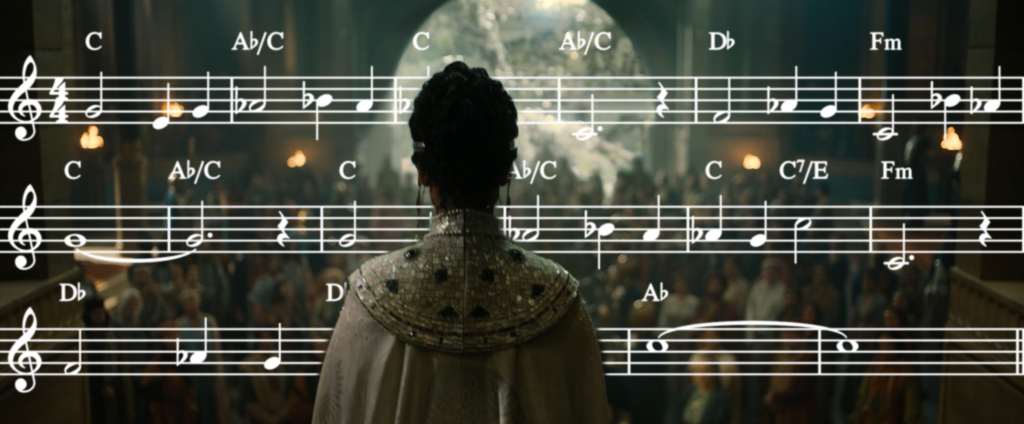
The sequence begins with the chiming of ceremonial bells, as Míriel emerges before the expectant crowd, ready to be crowned queen. Rich choral textures herald her with Adûnaic lyrics.
Adûnaic:
Ha-rasām an Ēru, rīgān kēvōnī,
Zūlud an-Ūrī, abāra, arūrasām.
Abāra.
English:
The power of God, newly crowned.
Rising Dawn, faithful, sovereignty.
Faithful.
Jubilant soaring brass tones offer a righteous statement of the Númenor theme, supported by its signature frame drums and melodic soloists. As usual, its harmonic support is built around major chords. This marks the last time this season that the rousing march of the Númenor theme is presented in a wholly positive light. I hope you enjoyed it while it lasted.
A jeering crowd interrupts Míriel’s ceremony, violating centuries of tradition. Just as she nearly calms them, Eärien bursts in with the palantir she found in the king’s hidden chamber. The clever and ambitious Pharazôn publicly puts Míriel in a position where she must claim it, and when she does, a riot ensues. All of these moments are accompanied by dramatic shifts in the score. Then, when events are at their most chaotic, a great eagle lands, amidst a swirl of orchestral strings! Here, the choir offers a majestic entrance for the magnificent creature.
Quenya:
Hlápula sorni, Métim’ aran, arpo.
Kilina túrin, Kév’ árë.
English:
Soaring eagles, Final king, usurper.
Chosen ruler, A new day.
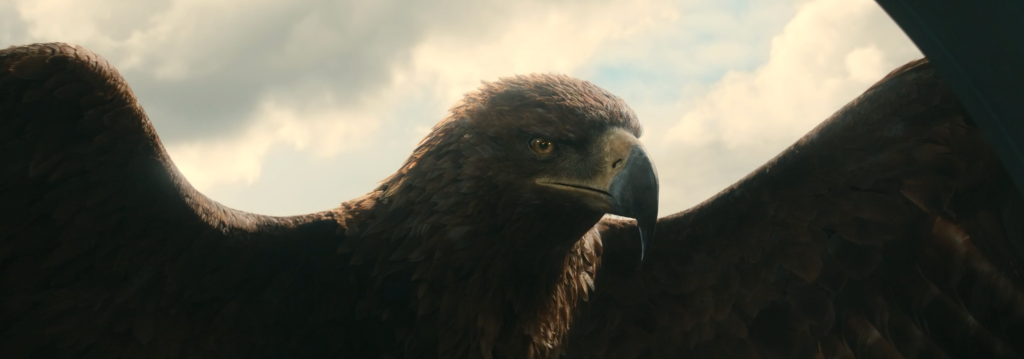
While the brass swells, Pharazôn seizes his opportunity: he steps forward and takes a king’s place before the bird, suddenly anointed as Númenor’s new ruler. Pharazôn has always been played with conniving menace by Trystan Gravelle, and here he communicates the man’s ambition and disloyalty all without saying a word. The choir supports Pharazôn’s grandstanding before the great eagle with an ironic quotation of a line Gandalf says to his eagle companions in Tolkien’s The Hobbit,translated into Quenya.
Quenya:
Nai i súrë nu rámalyar koluva lye
yondenna yassë Anar kiryasta ar Isil pata
English:
May the wind under your wings bear you
where the sun sails and the moon walks

At this climactic scene, the Númenor theme returns with all its muscular might; however, its two foundational major chords have both been turned minor. This shift colors the entire theme through a sickly, malicious lens. What was once beautiful about Númenor now exposes Pharazôn’s avarice and ambition. From this point onward, I will refer to this minor variant of the Númenor theme as the King’s Men theme. The King’s Men and the Faithful will continue to clash, and so too will their themes. Pharazôn holds his sword aloft and the crowd roars, as the theme resolves to the relative minor of what was once a triumphant and beautiful harmonic progression.
INTO THE FIRE
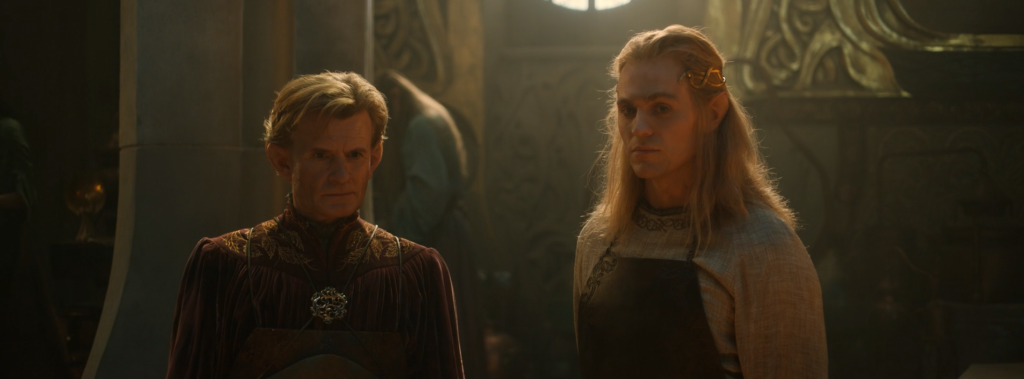
“The Eagle and the Sceptre” ends with a mysterious coda, returning to the forge tower in Eregion where Annatar and Celebrimbor receive mithril from the Dwarves and begin to forge anew. Ripples of liquid ore from the forge are mirrored by a cascading waterfall of orchestral string gestures. A child soprano sings the haunting melody of the Rings theme. However, when the camera settles on Annatar standing before the forge, the score offers a heretical secret. The final four notes of the first phrase of the Rings theme twist instead into the first four notes of the Sauron theme. The lyrics for both passages prophesize the end result of this forging, singing in Quenya “Otso Nornaherin ondohrótassen,” meaning “Seven for Dwarf-lords in their halls of stone.” Again and again, the score teases Sauron’s presence, practically begging the other characters in the scene to figure it out. Alas, only the audience is yet aware of what is happening.
Celebrimbor receives mithril from King Durin, who has agreed to partake in the creation of Rings of Power. Low brass and male choir offer a brooding statement of the Rings theme as Celebrimbor hands the mithril to Annatar, who drops it into the glowing ore. The score ramps to a furious final note as Annatar and Sauron exchange a brief glance.
BONUS TRACKS
I felt the episode-specific soundtrack album for “The Eagle and the Sceptre” the perfect place to debut a few more bonus tracks that fans had been asking me for. This album includes “The Rings of Power – Title Announcement Trailer,” the score I wrote for the memorable trailer in which the series title was announced with a jaw-dropping display of blacksmithing. Imbued with a quotation of the Stranger theme, this piece of music was the first example of my score for this series ever heard by the public.
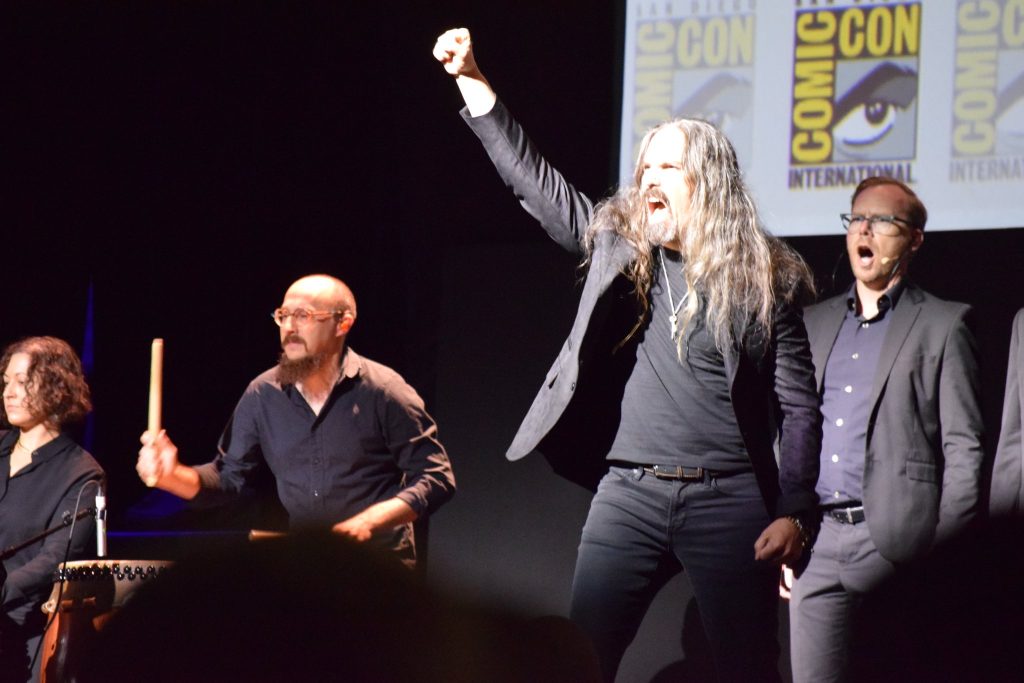
I also included here “The Rings of Power – Season Two Overture,” the blending of “Sauron” and “Nampat” that was crafted for the show’s second-season Hall H debut at San Diego Comic-Con in 2024. Standing before a group of chanting male singers and taiko drummers, I took to the stage and screamed “Death!” in Tolkien’s Black Speech to a crowd of seven thousand fans—one of the most fun performances of my life!
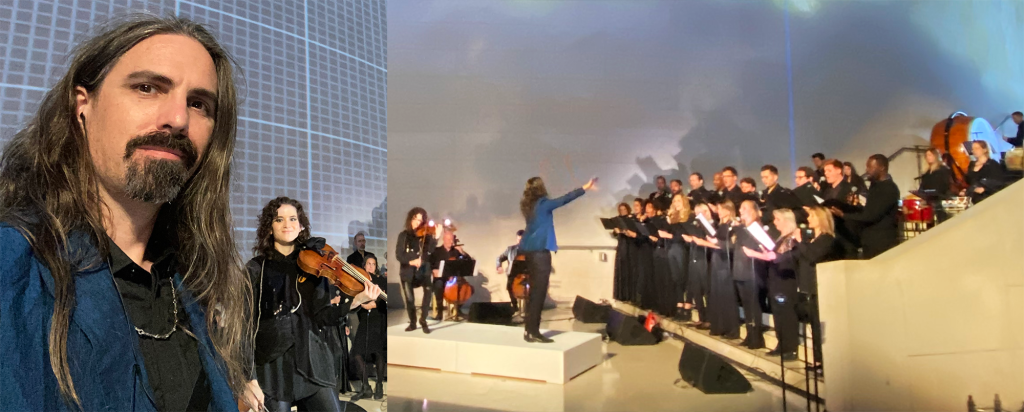
The last bonus track is “The Rings of Power – London Premiere Season One Fanfare.” This is a piece that was debuted in connection with the series’s London premiere event in 2022. I arranged a score suite for taiko drums, choir, celli, and virtuoso violinist Sandy Cameron. This was the last piece of music I composed in connection with the first season, so I am thrilled that fans can finally experience it in an album format.
With new themes presented for Shelob and Estrid, a hint of extreme metal for Damrod, and ominous new variations of the Númenor theme, the score to “The Eagle and the Sceptre” was a joyous challenge to tackle. However, more challenges awaited in the next episode, for which I had to write music for several beloved Tolkien concepts that had never before been included in any screen adaptation of the material.
Looking ahead, one task felt especially daunting: writing music for a character with a bright blue jacket and yellow boots!
—Bear
